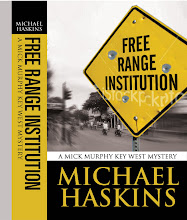
Michael Haskins
Showing posts with label journalism. Show all posts

Friday, August 27, 2010

Grammar is changing

Writers, both published and unpublished, continue to learn their craft everyday.

Sometimes we, as writers, overlook the few good books available that explain the rules of how and what we do. I don’t mean the glut of books that tells you how to write the best selling novel. Nope. I am talking about the books that explain the rules and even how to break them and how the rules are changing, being challenged.

I have talked a few times at the college library and other events about writing. I have always brought three books with me. Jack Hart’s “A Writer’s Coach,” Roy Peter Clark’s “Writing Tools,” and Steve King’s “On Writing.”

The first two books explain writing – journalist and novelist – by examining style and rules and the why-and-wherefore of the rules. Both books have been of great value to me as both a journalist and mystery writer.

King’s book, of course, tells the reader the procedures for writing that work for him. Most of them work for me. I suggest, in my talk, that these books will help anyone interested in fiction or journalism.

Clark is a scholar and vice president at the Poytner Institute, one of the most prestigious schools for journalist in the world. He writers a column for the Poytner newsletter called “Writing Tools” and his book by the same name is made up of those columns. I read the column, save them actually, so I can read them again.

God, it is said, loves drunks, fools, and Irishmen and I am batting a thousand. Late last week I emailed Clark and asked if he was going to publish the current columns in book form. He replied that his new book, The Glamour of Grammar, would be out in a week and was reviewed in the coming Sunday New York Time Review of Books. I ordered Clark’s new book before I read the review. My copy of the Time’s book review section usually comes before Sunday, via mail. I got it Friday and the review was outstanding. As I expected.

The book came Monday and I have begun reading it. I was not the best English student in high school – OK, I was lucky to get by with a C- – but if they taught English using Clark’s book as a text I might’ve been an A+ English student!

Get the title of some of his chapters: Enjoy, rather than fear, words that sound alike; Learn seven ways to invent words; Use the period to determine emphasis and space; Use the semicolon as a ‘swinging gate.’ The list goes on.

Just as the publishing world is changing, so is the world of grammar. Some fight the changes and some, like Clark, cherish the challenges the change brings.

I recommend “The Glamour of Grammar” to anyone that wants to write and understand the why and how to use grammar for today. I will be adding it to my traveling book collection, if I am eve asked to speak again.

It is also good to finally realize that while Mr. Carlin may have done his best to flunk me in his high school English class, Mr. Clark might have given me a B, maybe even a B+, if he had been teaching.

Google Poytner Institute and you too can get its almost daily report that runs Roy Peter Clark’s column, "Writing Tools." Catch up with the future.

Sunday, August 10, 2008

SLING WORDS - BLOG REVIEW


“Chasin' The Wind”
by Michael Haskins Hardback: 238 pagesPublisher: Five Star, Gale Cengage LearningISBN-13 978-1-59414-638- Copyright 2008

The cover of Chasin' The Wind has palm trees gilded by a setting sun and a boat, silhouetted on a patch of gleaming water. All else in the peaceful scene is darkness. The cover artist perfectly captured the essence of this book, the first Mad Mick Murphy Mystery, by Michael Haskins.

Set in Key West, the darkness beneath the bright surface of this tourist mecca is revealed in the opening sequence when Murphy, former globe-trotting investigative journalist, stumbles upon the near-dead body of his friend and fellow sail enthusiast.

Haskins has a lean, spare style that gives you the facts and paints a picture of the Key West known to its denizens but rarely seen by the tourists. Forget the glitz and glamor of the other odes to Floridian excess as seen in book, television, and film. "Chasin' The Wind" is the real deal. It's the bite of lime in a mojito, the festering, relentless antipathy still nurtured for Fidel, and the spray of salt in your face when you're on the water.

Mick Murphy is not some unrealistic super hero sleuth. He might be the guy you pass on the street. He's known tragedy, and he's haunted by the past. He probably isn't extraordinary in his beliefs: that loyalty and friendship are everything and that justice should be sought.Haskins has created an intelligent sleuth, and you'll get a kick out of following Mad Mick Murphy from Key West to Cuba in "Chasin' The Wind."

You'll wish you could hang with Murphy in a seedy bar and share a beer while you wait for the next book in this promising new series.

Takeaway Truth:
Small publishers are nurturing some big talent. If you're a reader, start buying some of these heretofore-unknown authors on a regular basis.

ABOUT THE REVIWER:
SLING WORDS aka Joan Reeves.
Just call me Paige Turner. Oh. Real name is displayed? Well, darn. I was hoping the Paige Turner moniker might make me a hot commodity. Guess that means I'll have to write great fiction instead. (But that's sooo hard! *whine, whine*) You want to know more about me? Hmmm.... At this moment in time, I guess I'm a multi-published author of fiction and a hard-working freelance writer published all over the web (under my own name, pseudonyms, and as a ghost)...yada yada yada. Need to know more? Just go to http://www.joanreeves.com,/ for details. Joan donates the copies of books she reviews to various libraries.

Thursday, March 20, 2008

The AP Stylebook and language

I am up early each morning, to the chagrin of Celine, and usually switch the TV news shows between the local ABC and Fox news programs. I am most interested in the expected weather conditions and both stations give predictions for Key West, even though the stations are in Miami or thereabouts.

I’ve been involved in journalism most of my life and, unlike fiction, journalists have stylebooks that give rules on writing. I used the AP Style Book in Boston and, again, years later, in Key West.

What does early morning TV and AP Stylebooks have to do with one another? I’m glad you asked. On both TV stations, the weather person and traffic reports use the word “towards.”

“The storm is moving towards Miami.”

“The traffic has stalled north bound towards the 95 from the interchange.”

Wondering what’s wrong? I think most people would because, more and more, I hear people using “towards” in conversations.

I wrote a business story a long time ago and the editor at the Key West Citizen, Bernie Hunt, pointed out to me that in American English there ain’t no such word as “towards.”

“It’s a British usage,” he told me and, being an Irishman who grew up outside London, Bernie would know. He also was part of the news team in San Diego, California, who won the Pulitzer for newspaper coverage of a commercial airliner that crashed at the city’s airport.

Since then, whenever I hear someone on the TV news use “towards,” I cringe. Shouldn’t the electric media know better?

It doesn’t end there. The word “over” is another misused word that drives me crazy and this one, I admit, I regularly abused. That is, until copy editor Van Trotter explained the correct used of “over” and “more than.” We were at the Green Parrot Bar on Whitehead Street, a couple of blocks from Ernest Hemingway’s home. A journalism background didn’t hurt Hemingway’s writing and, some would say, it helped him form his unique style.

Somehow, Van and I got to talking about work and he told me every time he drives by a MacDonald’s he goes crazy when he sees the golden arches and the words: over a billion sold (maybe it says 10 billion, but you get my point).

“Over!” Van said, or maybe even yelled and scared some of the late-night drinkers (this was after we put the paper to bed at 11 p.m.). “The cat jumped over the moon, is right, but over a billion sold, is wrong!”

So, what’s the right way? “More than a billion sold,” he said. “If it involves math, numbers, comparison, it’s ‘more than’ not over. Numbers don’t jump over things.”

The AP Stylebook has pages and pages of correct usages for newspapers. So why, as mystery writers should this interest us? I think it is important that we get it right in our stories. And, getting it right might be having a character use the wrong “towards.” It is also a good idea not to have someone educated in England use “toward.”

Idioms change by locations. Sayings that make sense to someone in Boston may confuse the hell of a person in Mississippi. For example, in N. Quincy, where I grew up we called soft drinks “tonic.” When I moved to California, it took me a good year to stop asking for tonic when I wanted a Coke or Pepsi. Tonic, in most other states is just that, tonic water. Gin and tonic, please.

So, if I was reading your story and the character was from Massachusetts, maybe Quincy, and he or she asked for a “soda pop,” I would notice your mistake.

Mystery writers don’t usually kill people or blow up buildings, or do the crimes they writer about, but they do have to research guns and bombs and violent death. It shouldn’t stop there. Maybe Hemingway was not entirely wrong when he said, “writer what you know.”

I would be hard pressed to write a Faulkner story, since I have never traveled through, or lived in the Deep South. Remember, from Key West you have to travel north to reach the South! Honest.

So, know your characters and where they are from. If they are from somewhere you ain’t been, rethink them. Because there are readers out there that will write you every time you make a mistake with a weapon, locale, boat, airplane, or accent!

FEEDJIT Live Traffic Map