I can remember using a typewriter on one of my many unpublished novels back in the mid ‘80s. Soon afterward, two friends pulled me kicking and screaming into the computer generation. I finally welcomed the scary process because of spell checker.
Today, of course, spell checker is only a little of what writers get from writing programs. There is auto correct, a favorite of mine, since my mind often works far ahead of my fingers, and I am always transposing letters. I have many words, like because, in auto correct. For whatever reason, when I am going along at a good pace, I spell because “becuase.” No rhyme or reason, it usually comes out that way, but with auto correct, the computer fixes it. That’s a major saver when I click on spell check.
Good things in life have a tendency to turn bad and it’s usually because of the involvement of humans.
Take nuclear power. If that were all it was, our power bills would be low, our skies would be clean, and maybe global warming would never have happened. However, some genius figured a way to make a world-destroying weapon using nuclear waste . . .
I am not sure which came first, the weapon idea or the power idea, but you get my point. Now, you want to know how this connects to computers, right?
The Internet followed the computer. Wow! Research at your fingertips. I was a reporter in Boston and when you needed information, if it wasn’t in the paper’s morgue, you went to the library or the source. Image that, walking the streets of Boston in rain or cold or summer humidity to work on a story.
Not today, all any reporter has to do is Google and all that research is there for them, in the air-conditioned comfort of the city room.That’s a bad thing. It has taken the human contact I had as a reporter out of the process and in journalism, the human contact is very important. In addition, it makes journalists lazy.
Nevertheless, I do admit, for research as a mystery writer, Google is a benefit. I am fortunate to have friends and contacts in military intelligence, and the local police force, as well as the national weather service. These personal contacts have been of more concrete help in my writing than if I only had Google.
Now we enter the millennium and humans are still at work screwing up good things.
To a writer, time is everything. Time to write, edit, think, read. I would guess that most writers would argue in favor of a 30-hour day, not a 24-hour day. And, of course, 30-hours wouldn’t be enough.
Writing can be lonely. You open the day by staring at blank computer screen and you have to get what’s in your head onto it. Sounds easy, but ask anyone that has tried it. Writers, and I am generalizing here, are great procrastinators. We don’t need to be offered more ways to put off writing. We need more incentives to sit down and write.
A little more than a year ago, a writer friend knew I was promoting my book, Chasin’ the Wind, and suggested I get on FaceBook. I did and it was great for my procrastination process. Then another writer friend sent me another site and soon I had a list of sites and blogs I HAD TO READ.
Here is where a good thing has gone bad.
My usually schedule was to get up at 6 a.m., make my café con leche and write until 9 a.m., or, on a good day, until noon. Then I would have lunch and read into the early afternoon and somewhere, if possible, I would watch the taped edition Morning Joe.
Now, I have never sat from six to nine or noon without getting up. I get another café con leche, I listen to CNN while pondering some dialogue I want to get right, or try to figure out how to get my character out of a situation, realistically, that I have put him or her in. Sometime I face the blank page and panic because I fear writer’s block.
But, eventually, I get my time in. My word count (I note it each day) maybe only a couple of hundred words, or a thousand. I also edit as I write. So, if stuck on something, I will often go back and reread and edit.
What I found myself doing, after my friend turned me onto FaceBook, was checking my emails at 6 a.m., answering my FaceBook friends and then going to the blogs I HAD TO READ. It is amazing how fast three-hours can fly by when you are on the Internet. Also, I find those three-hours are mentally exhausting and that hurts my writing.
I cannot change the Internet, but I can control that section on my computer. I do check my emails at 6 a.m. because I have family around the country and it is how we communicate (though I would rather use the phone). However, I do not answer emails from FaceBook until late afternoon or early evening, and I have cut many of the blogs out that I HAD TO READ.
I must admit to enjoying Crime Always Pays and Criminal Brief daily. I also check other writers’ blogs, but no longer daily.You cannot afford to waste time and the clutter on the Internet steals your time, especially if you are a writer. The computer is a great thing and the Internet is amazing, just don’t let it takeover your life.
www.michaelhaskins.net
Saturday, April 18, 2009
Wednesday, March 4, 2009
SleuthFest Notes
I just returned from the four-day SleuthFest gathering of writers and fans in Deerfield Beach, Fla. It is sponsored by the Florida chapter of the Mystery Writers of America (I am on the chapter’s board) and its two guests of honor were writers John Hart and Brad Meltzer. John spoke at the Friday luncheon and Brad on Saturday.
Taking the weekend (Thursday – Sunday) out of order let me say the guest speakers gave interesting talks. Both are recovering attorneys (as were many in the crowd), but what else they had in common interested me a lot more. John and Brad agreed that perseverance was important to writing, but then they each added that luck was the big secret ingredient in their success. They talked about their many rejections, but the luck of finding one person (an agent or editor or publisher) that saw something in their manuscript that twenty-four or more others didn’t see.
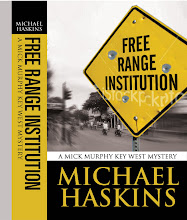
I attended the “Agents’ Roundtable” at 10 a.m. and met Jill Marsal, an agent, who is now looking at my second novel, “Free Range Institution.” At 11 a.m., I attended the “Creating Memorable Characters,” with panelists Barbara Graham, Leighton Gage, Jeremiah Healy and moderated by our favorite bookseller Joanne Sinchuk.
After the luncheon, I attended the Supernatural Sleuths & Vampire Villains, with Deborah LeBlanc and Joe More. Let me tell you, they are two great panelists. Joe writes a thriller and if you liked the Da Vinci Code, you’ll love Joe and Lynn Sholes series. Deborah, from New Orleans, writes about the supernatural and has stories of her experiences into the supernatural that can curl your hair!
We were off to the hotel bar, after that!
Saturday, I was a panelist at the 10 a.m. “Working with the Police and other Experts” panel with Randy Rawls and P.I. Steve Brown. Randy is retired military intelligence (I know, it’s an oxymoron immortalize by Capt. Flagg on the old M*A*S*H* TV show), I have friends and people who have helped me that are local cops, FDLE, DEA and JIATF, so I guess that qualified me to be on the panel.
Afterward, at 11 a.m., I went to the “Anatomy of a Thriller” panel, with Joe Moore, Nicole Kenealy, and Benjamin Leroy (Bleak House Books).
I spent the rest of the afternoon with writer Leighton Gage, an American who lives in Brazil and writes about a Brazilian federal police officer. A well-written series gives the reader a look into the Brazilian police system. Leighton and his wife, Eide, are great people and we hung around the pool talking shop, like book signings, getting published, getting paid, and the co
st of traveling and book signings! He was on his way to the Northeast (good luck with the current weather) for more book signings before heading to visit family in Europe.
Also got to hang with retired FDLE agent Buck Buchanan. Buck is a writer who is battling the good fight to get published. He is a friend of chapter prez and FDLE agent Jim Born. He had an agent appointment to pitch his book and was asked to send the manuscript in, so he was in a good mood.
Also hung out with P.I. Steve Brown. Now there’s a guy whose mind you wanna pick if you are writing a P.I. novel. His book, “The Complete Idiot’s Guide to Private Investigation,” now sits on my bookshelf. The title tells you all about the book.
I enjoyed SleuthFest, feel it is well worth the financial investment, and would be for wanna-be writers because mystery writers are a friendly bunch and always seem willing to talk to you and offer advice. Sometimes it is just good to hear someone else has gone through the rejections before finding success. Writing is a lonely business and full of strange people, so it’s good to mingle with other writers and find out you are not all that strange.
I am getting ready to make a road trip to my daughters in the NY/NJ area (weather permitting) in a week and will be gone for a month. If something interesting happens, I will blog it.
Please, Google the writers I’ve mentioned, they are great people and I am sure most of you will find their books a good investment of your time and money.
www.michaelhaskins.net
Taking the weekend (Thursday – Sunday) out of order let me say the guest speakers gave interesting talks. Both are recovering attorneys (as were many in the crowd), but what else they had in common interested me a lot more. John and Brad agreed that perseverance was important to writing, but then they each added that luck was the big secret ingredient in their success. They talked about their many rejections, but the luck of finding one person (an agent or editor or publisher) that saw something in their manuscript that twenty-four or more others didn’t see.
I have perseverance, just by the fact that after many years of writing I finally was published and I am still writing and waiting to hear about my sequel. Now, if I could just find out where luck is hiding, I would go and try to seduce it.
I was on two panels. Friday, 2:15 p.m., I was a panelist on “Wright Great Dialogue” with Terry Odell, Deborah Shlian and Joan Johnston, with moderator Gregg (my father wanted a boy) Brickman (PHOTO above). You can read about that panel in my last posting.
The panel was well received and four of us had different suggestions and opinions on what good dialogue was.
I was on two panels. Friday, 2:15 p.m., I was a panelist on “Wright Great Dialogue” with Terry Odell, Deborah Shlian and Joan Johnston, with moderator Gregg (my father wanted a boy) Brickman (PHOTO above). You can read about that panel in my last posting.The panel was well received and four of us had different suggestions and opinions on what good dialogue was.
I attended the “Agents’ Roundtable” at 10 a.m. and met Jill Marsal, an agent, who is now looking at my second novel, “Free Range Institution.” At 11 a.m., I attended the “Creating Memorable Characters,” with panelists Barbara Graham, Leighton Gage, Jeremiah Healy and moderated by our favorite bookseller Joanne Sinchuk.
After the luncheon, I attended the Supernatural Sleuths & Vampire Villains, with Deborah LeBlanc and Joe More. Let me tell you, they are two great panelists. Joe writes a thriller and if you liked the Da Vinci Code, you’ll love Joe and Lynn Sholes series. Deborah, from New Orleans, writes about the supernatural and has stories of her experiences into the supernatural that can curl your hair!
We were off to the hotel bar, after that!
Saturday, I was a panelist at the 10 a.m. “Working with the Police and other Experts” panel with Randy Rawls and P.I. Steve Brown. Randy is retired military intelligence (I know, it’s an oxymoron immortalize by Capt. Flagg on the old M*A*S*H* TV show), I have friends and people who have helped me that are local cops, FDLE, DEA and JIATF, so I guess that qualified me to be on the panel.
Afterward, at 11 a.m., I went to the “Anatomy of a Thriller” panel, with Joe Moore, Nicole Kenealy, and Benjamin Leroy (Bleak House Books).
I spent the rest of the afternoon with writer Leighton Gage, an American who lives in Brazil and writes about a Brazilian federal police officer. A well-written series gives the reader a look into the Brazilian police system. Leighton and his wife, Eide, are great people and we hung around the pool talking shop, like book signings, getting published, getting paid, and the co
st of traveling and book signings! He was on his way to the Northeast (good luck with the current weather) for more book signings before heading to visit family in Europe. (PHOTO above, Buck, me and Leighton -notice sign behind us? The bar was in front of us, enough said.)
Also got to hang with retired FDLE agent Buck Buchanan. Buck is a writer who is battling the good fight to get published. He is a friend of chapter prez and FDLE agent Jim Born. He had an agent appointment to pitch his book and was asked to send the manuscript in, so he was in a good mood.
Also hung out with P.I. Steve Brown. Now there’s a guy whose mind you wanna pick if you are writing a P.I. novel. His book, “The Complete Idiot’s Guide to Private Investigation,” now sits on my bookshelf. The title tells you all about the book.
I enjoyed SleuthFest, feel it is well worth the financial investment, and would be for wanna-be writers because mystery writers are a friendly bunch and always seem willing to talk to you and offer advice. Sometimes it is just good to hear someone else has gone through the rejections before finding success. Writing is a lonely business and full of strange people, so it’s good to mingle with other writers and find out you are not all that strange.
I am getting ready to make a road trip to my daughters in the NY/NJ area (weather permitting) in a week and will be gone for a month. If something interesting happens, I will blog it.
Please, Google the writers I’ve mentioned, they are great people and I am sure most of you will find their books a good investment of your time and money.
www.michaelhaskins.net
Thursday, February 12, 2009
SleutFest Panel - Write Great Dialogue
I will be on the “Write Great Dialogue” panel at the Florida chapter of MWA’s SleuthFest 2009 at the Deerfield Beach Hilton, Feb. 26 – March 1 (http://www.mwa.fla.org/), along with Terry Odell – www.terryodell.com; Deborah Shlian - www.shlian.com; Joan Johnston – www.joanjohnston.com, and moderator Gregg Brickman – http://www.greggebrickman.com/, on Friday, Feb. 27, 2:15 p.m. We follow the luncheon where chapter President Jim Born – http://www.jamesoborn.com/ - introduces guest speaker John Hart – www.johnhartfiction.com.
The three-days of panel topics is online and a good event for the writer, the wannabe writer and mystery fans. Check it out.
I am not sure why someone thought to add me to the panel, but I would like to think it had to do with that someone reading my book (Chasin’ the Wind) and being impressed with the dialogue in it. A while back, in my blog, I wrote about hanging out at the Hog’s Breath Saloon and Schooner Wharf Bar, and how it had more to do with noticing how people (especially tourists trying to fit in and have a good time) talked and intermingled, then it did with drinking too much Kalik beer or Jameson. Some people even believed me!
As reading is important to writers as writing, observation of people is important to good, sorry, “great dialogue.” A paragraph or half page of dialogue needs something to make it move and that something is short description of how people talk. I sat and watched a man try to pick up a young woman at the bar and while he talked he absentmindedly pulled at his earlobe every so often. Did he do it on purpose? I doubt it, I think it was a habit he’d had for a long time.
Another time, I sat close to three young women who were having fun drinking their rum-and-cokes and key lime cocktails and talking about the men sitting around the bar and two of the band members. One young lady, with red hair hanging past her shoulders, twirled her fingers through a few lose strands of hair and neither her friends nor she were aware of her doing it. It was a habit of her’s and no one paid attention to it (but me).
Adding these small habits to break up a long paragraph of dialogue helps the reader take a breath and is important.
Observation is important and so is listening. One advantage of hanging out at the Hog and Schooner Wharf and the Green Parrot, is you get to hear all kinds of accents; foreign as well as regional. While too much accent in written dialogue will bore your reader, the right sprinkling of it will get your point across and your character identified.
Going back to junior high school (you know the old red, one-room schoolhouse), I always remember one thing I learned (Okay, so I wasn’t the best student in the room, but I did learn something!) from the teacher and that was that the way someone from a place pronounced its name was the correct way to say it. When you do that in writing, you usually have to spell a word phonetically.
I have friends from the great state of Louisiana and learned from listening to them that they pronounce it ‘Lous-E-anna.’ One evening I was sitting at Schooner Wharf with my friend Bob Pierce and at the table next to us, four young, collage-aged women were having a hell of a good time. One wore a LSU T-shirt. We were smoking cigars and one asked if it was all right for them to smoke cigars. We assured them it was and told them the cigar roller at the bar had small, flavored cigars, but they wanted ‘real’ cigars. Bob walked two of them to the cigar roller and they came back with fresh cigars. We showed them how to cut and light them. Next round of drinks was on them (seems Bob paid for the cigars – you know how those Texas gentlemen can be). I thanked them and asked where in ‘Lous-E-anna’ they were from.
They laughed, not at me, but in amazement, they said, because they’d never heard a Yankee pronounce their state’s name properly.
While I don’t hear my Boston accent, people that meet me for the first time usually catch it, or think I am a New Yorker (God forbid, I’m a Red Sox fan!). While we may all speak English, there are dialects. Talk to an Irishman or a Scotsman just off the boat and you need a translator!
What am I going to bring to the panel? I guess it will be to tell those in the audience that to write great dialogue the writer needs to listen to people, their accents and observe their distinctive gestures while talking, to be able to capture the whole picture. After all, do you want to read pages and pages of straight dialogue? I know I don’t. I want to be able to see the speaker, as he/she uses hand gestures and other body language as the conversation moves forward. It even works in short sentances and helps identify a speaker without repeating his/her name with he said/she said.
What do you think? Please let me know.
The three-days of panel topics is online and a good event for the writer, the wannabe writer and mystery fans. Check it out.
I am not sure why someone thought to add me to the panel, but I would like to think it had to do with that someone reading my book (Chasin’ the Wind) and being impressed with the dialogue in it. A while back, in my blog, I wrote about hanging out at the Hog’s Breath Saloon and Schooner Wharf Bar, and how it had more to do with noticing how people (especially tourists trying to fit in and have a good time) talked and intermingled, then it did with drinking too much Kalik beer or Jameson. Some people even believed me!
As reading is important to writers as writing, observation of people is important to good, sorry, “great dialogue.” A paragraph or half page of dialogue needs something to make it move and that something is short description of how people talk. I sat and watched a man try to pick up a young woman at the bar and while he talked he absentmindedly pulled at his earlobe every so often. Did he do it on purpose? I doubt it, I think it was a habit he’d had for a long time.
Another time, I sat close to three young women who were having fun drinking their rum-and-cokes and key lime cocktails and talking about the men sitting around the bar and two of the band members. One young lady, with red hair hanging past her shoulders, twirled her fingers through a few lose strands of hair and neither her friends nor she were aware of her doing it. It was a habit of her’s and no one paid attention to it (but me).
Adding these small habits to break up a long paragraph of dialogue helps the reader take a breath and is important.
Observation is important and so is listening. One advantage of hanging out at the Hog and Schooner Wharf and the Green Parrot, is you get to hear all kinds of accents; foreign as well as regional. While too much accent in written dialogue will bore your reader, the right sprinkling of it will get your point across and your character identified.
Going back to junior high school (you know the old red, one-room schoolhouse), I always remember one thing I learned (Okay, so I wasn’t the best student in the room, but I did learn something!) from the teacher and that was that the way someone from a place pronounced its name was the correct way to say it. When you do that in writing, you usually have to spell a word phonetically.
I have friends from the great state of Louisiana and learned from listening to them that they pronounce it ‘Lous-E-anna.’ One evening I was sitting at Schooner Wharf with my friend Bob Pierce and at the table next to us, four young, collage-aged women were having a hell of a good time. One wore a LSU T-shirt. We were smoking cigars and one asked if it was all right for them to smoke cigars. We assured them it was and told them the cigar roller at the bar had small, flavored cigars, but they wanted ‘real’ cigars. Bob walked two of them to the cigar roller and they came back with fresh cigars. We showed them how to cut and light them. Next round of drinks was on them (seems Bob paid for the cigars – you know how those Texas gentlemen can be). I thanked them and asked where in ‘Lous-E-anna’ they were from.
They laughed, not at me, but in amazement, they said, because they’d never heard a Yankee pronounce their state’s name properly.
While I don’t hear my Boston accent, people that meet me for the first time usually catch it, or think I am a New Yorker (God forbid, I’m a Red Sox fan!). While we may all speak English, there are dialects. Talk to an Irishman or a Scotsman just off the boat and you need a translator!
What am I going to bring to the panel? I guess it will be to tell those in the audience that to write great dialogue the writer needs to listen to people, their accents and observe their distinctive gestures while talking, to be able to capture the whole picture. After all, do you want to read pages and pages of straight dialogue? I know I don’t. I want to be able to see the speaker, as he/she uses hand gestures and other body language as the conversation moves forward. It even works in short sentances and helps identify a speaker without repeating his/her name with he said/she said.
What do you think? Please let me know.
Wednesday, February 4, 2009
Bob Morris & the USA Today Syndrome
My friend and fellow mystery writer Bob Morris – www.bobmorris.net - taught me something about myself recently when he was at Murder on the Beach Bookstore – www.murderonthebeach.com - in Delray Beach to sign his new Zack Chasteen novel, “A Deadly Silver Sea.”
Bob read a printout version of my novel, “Chasin’ the Wind,” and gave me a nice blurb for the cover, long before we had actually met. He did it because he’s a nice guy and, like most mystery writers, remembers what it was like to get that first novel out. That and the fact that I really enjoyed his other Zack Chasteen novels, “Bahamarama,” “Jamaica Me Dead,” and “Bermuda Schwartz,” made my driving almost 200 miles to the bookstore an enjoyable trip. Of course, the fact that Bob also is known for serving a sampling of his famous rum mojitos at his signing was also another reason for the drive.
By 7 p.m., the bookstore was standing room only and I got to see Deb Sharp – www.deborahsharp.com – and talk about first publications and got to discuss my book with some of the guests while we sipped mojitos and waited for Bob to talk.
Bob stood up in front of the crowd, ignoring the overstuffed chair, and began to explain how in the new book he had to go into different voices to make it work. Not to give the plot away, but the story takes place on a luxury cruise ship and the action is nonstop.
One of the things Bob said to me, after reading, “Chasin’ the Wind” was that he liked that my chapters were short and ended with him wanting to turn to the next chapter so he could answer the question or see the solution to the dilemma that ended the previous chapter.
Bob explained the difficulty of writing a book that took place on a cruise ship and how he came about deciding to use different voices in telling the story. Then he talked about why his chapters were short. He explained that he saw his chapters as scenes in a TV show or a movie and went into a little of his background in advertising and entertainment.
I sat there and realized how right he was about chapters being scenes. I had spent most of my wayward youth in Los Angeles working on TV shows and thought maybe that explained why I also wrote short chapters.
Of course, I began with short chapters because of what I call the “U.S.A. Today syndrome.” People are busy today and want to see everything capsulized as U.S.A Today does to the news and as televised news does in its broadcasts.
I don’t really outline my story, but I do make notes on things that should happen and begin giving them chapter numbers. Usually, that goes away because the story begins to write itself and some ideas are tossed aside and others move further up in the storyline and, on occasion I even have to go back and insert something I thought would work further in the story back to an earlier chapter.
I was interviewed on Sun Radio, 95.5 FM, here in Key West, by morning DJ Bill Hoebee and one of the nice things Bill said about my books was that he began it, got hooked on the short chapters and kept wanting to put the book down but needed to know the answer/solution to how the last chapter ended. He said, on air, that by midnight he had to stop reading because he had to be up at 3 a.m. to get to the station. He also mentioned that it was the first novel he’d read since leaving college, because it was an easy read that hooked him. From Hoebee’s lips to readers’ ears!
Not all chapters are short, but most are within the three-to-five page range. I read a lot of news magazines and newspapers and have noticed I usually avoid the “in-depth” pieces unless it’s a subject that really interests me, but I will read many of the shorter pieces. I do this, of course, looking for idea germs and maybe a little something that I can use in background for my novels and short stories.
Short chapters don’t work for everyone, but they seem to work for me, so I have kept it up and am working on my third book, “Car Wash Blues.” I am more aware of chapter length and reread them a little more often than I used to do, because I want to make sure the chapter works, and that I am not just trying to cut them to the bone and leave the reader missing the meat.
Do short chapters work for you? If they do, or don’t, let me know the reason, please.
www.michaelhaskins.net
Bob read a printout version of my novel, “Chasin’ the Wind,” and gave me a nice blurb for the cover, long before we had actually met. He did it because he’s a nice guy and, like most mystery writers, remembers what it was like to get that first novel out. That and the fact that I really enjoyed his other Zack Chasteen novels, “Bahamarama,” “Jamaica Me Dead,” and “Bermuda Schwartz,” made my driving almost 200 miles to the bookstore an enjoyable trip. Of course, the fact that Bob also is known for serving a sampling of his famous rum mojitos at his signing was also another reason for the drive.
By 7 p.m., the bookstore was standing room only and I got to see Deb Sharp – www.deborahsharp.com – and talk about first publications and got to discuss my book with some of the guests while we sipped mojitos and waited for Bob to talk.
Bob stood up in front of the crowd, ignoring the overstuffed chair, and began to explain how in the new book he had to go into different voices to make it work. Not to give the plot away, but the story takes place on a luxury cruise ship and the action is nonstop.
One of the things Bob said to me, after reading, “Chasin’ the Wind” was that he liked that my chapters were short and ended with him wanting to turn to the next chapter so he could answer the question or see the solution to the dilemma that ended the previous chapter.
Bob explained the difficulty of writing a book that took place on a cruise ship and how he came about deciding to use different voices in telling the story. Then he talked about why his chapters were short. He explained that he saw his chapters as scenes in a TV show or a movie and went into a little of his background in advertising and entertainment.
I sat there and realized how right he was about chapters being scenes. I had spent most of my wayward youth in Los Angeles working on TV shows and thought maybe that explained why I also wrote short chapters.
Of course, I began with short chapters because of what I call the “U.S.A. Today syndrome.” People are busy today and want to see everything capsulized as U.S.A Today does to the news and as televised news does in its broadcasts.
I don’t really outline my story, but I do make notes on things that should happen and begin giving them chapter numbers. Usually, that goes away because the story begins to write itself and some ideas are tossed aside and others move further up in the storyline and, on occasion I even have to go back and insert something I thought would work further in the story back to an earlier chapter.
I was interviewed on Sun Radio, 95.5 FM, here in Key West, by morning DJ Bill Hoebee and one of the nice things Bill said about my books was that he began it, got hooked on the short chapters and kept wanting to put the book down but needed to know the answer/solution to how the last chapter ended. He said, on air, that by midnight he had to stop reading because he had to be up at 3 a.m. to get to the station. He also mentioned that it was the first novel he’d read since leaving college, because it was an easy read that hooked him. From Hoebee’s lips to readers’ ears!
Not all chapters are short, but most are within the three-to-five page range. I read a lot of news magazines and newspapers and have noticed I usually avoid the “in-depth” pieces unless it’s a subject that really interests me, but I will read many of the shorter pieces. I do this, of course, looking for idea germs and maybe a little something that I can use in background for my novels and short stories.
Short chapters don’t work for everyone, but they seem to work for me, so I have kept it up and am working on my third book, “Car Wash Blues.” I am more aware of chapter length and reread them a little more often than I used to do, because I want to make sure the chapter works, and that I am not just trying to cut them to the bone and leave the reader missing the meat.
Do short chapters work for you? If they do, or don’t, let me know the reason, please.
www.michaelhaskins.net
Friday, January 30, 2009
Murder & Mayhem at the Bar / Amazon's Kindle
Mystery writers are a strange group. Our minds work differently than normal people. I was recently appointed, or maybe elected, to the board of directions of the Florida chapter of the Mystery Writers of America. Last weekend I attended the board meeting/chapter luncheon at the Deerfield Beach Hilton, an almost four-hour ride from Key West.
The luncheon speakers were columnists Oline Cogdill and writer/marketing Guru Sandy Balzo, who talked about the importance of a writer’s website, something I believe in. Afterward, writers Jerry Healy, Sandy Balzo, Kris Montee, and I sat at the bar. We were talking about writing and eventually discussed my current work-in-progress, Car Wash Blues.
I should add here, that the chapter’s monthly luncheon are usually held at the Deerfield Beach Hilton and the bartender was used to Jerry and other writers sitting at the bar talking about murder and mayhem, so she went about her duties and ignored us.
Okay, back to Car Wash Blues. Briefly, it is about Mexican cartel hit men coming to Key West in search of $20 million that was stolen from the Tijuana cartel and my character, Liam Michael ‘Mad Mick’ Murphy, accidentally witnesses a murder by cartel hit men in a car wash.
The Los Angeles Times has run a yearlong series, Mexico in Crisis, that covers the horrific crimes the cartels are committing now that the government of Mexico has made crushing the cartels a primary goal. I saved those articles and used them as research on the cartels. I should also mention that while I lived in S. California, I spent a lot of time in Tijuana and had many friends there and still keep in touch with some, so what has begun to happen there has really affected me.
Many of the Mexican cartels are into decapitation, none more so than the Tijuana gang. So, in bringing these gangsters to Key West I wondered if I should stick to the reality of their murders and decided I should.
I ran my decision by Jerry, Sandy, and Kris, while we sat at the bar. You can imagine how those sitting around us reacted with words like headless bodies, heads wrapped in burlap and used as soccer balls and crushing heads in a tortilla press, coming from the four people at the bar. The bartender just smiled.
I don’t think while we were discussing my murderous ways any of us thought it was an unusual topic for an afternoon, but I bet those sitting around us were wondering about us. One couple actually got up and left before ordering and I have to wonder if they overheard us and decided it was best to leave! Maybe, maybe not.
For me, the gathering at the hotel’s bar was an opportunity to pick the minds of other writers, something I cannot do while facing a computer screen. Living hours away from most writers in Florida, I miss the camaraderie of writers; though, I should say I do cherish the feedback I get from my friends in Key West, especially since many of them are readers and readers’ opinions are important to any writer.
SleuthFest, the chapter’s writing seminar, a mixture of writers, readers and fans, is scheduled for Feb. 26 – March 1. For information on the event go to: http://www.mwaflorida.org/sleuthfest.htm.
* * *
Amazon is preparing to change the publishing world with an announcement on its Kindle. While bookstores close because of declining sales, Amazon steams ahead and its profits indicate, to me at least, that Amazon is the future of publishing. I don’t like that and hope I am wrong, because I enjoy holding a book and turning pages.
Here what Shelf Awareness had to report in its Jan. 30 report:
In the quarter ending December 31, net sales at Amazon.com increased 18% to $6.7 billion, and net income rose 9% to $225 million.
“But in a sign that Amazon was not immune to the recession, its operating margins fell to 4.06% from 4.78%, a result of heavy discounting to persuade reluctant shoppers to buy," the New York Times reported.
“Amazon offered a broad estimate for the current quarter and did not make any estimate for the year, as it normally had. It said it expected operating income of as much as $210 million, a 19% increase over the first quarter of 2008. At its most pessimistic, the forecast was for a 9% increase.”
Sales of media, which includes books, rose 9% to $3.64 billion. The Times also noted that while Amazon released no new statistics on Kindle sales, a news conference is scheduled in New York on February 9 to introduce a new version of the electronic reading device.
The luncheon speakers were columnists Oline Cogdill and writer/marketing Guru Sandy Balzo, who talked about the importance of a writer’s website, something I believe in. Afterward, writers Jerry Healy, Sandy Balzo, Kris Montee, and I sat at the bar. We were talking about writing and eventually discussed my current work-in-progress, Car Wash Blues.
I should add here, that the chapter’s monthly luncheon are usually held at the Deerfield Beach Hilton and the bartender was used to Jerry and other writers sitting at the bar talking about murder and mayhem, so she went about her duties and ignored us.
Okay, back to Car Wash Blues. Briefly, it is about Mexican cartel hit men coming to Key West in search of $20 million that was stolen from the Tijuana cartel and my character, Liam Michael ‘Mad Mick’ Murphy, accidentally witnesses a murder by cartel hit men in a car wash.
The Los Angeles Times has run a yearlong series, Mexico in Crisis, that covers the horrific crimes the cartels are committing now that the government of Mexico has made crushing the cartels a primary goal. I saved those articles and used them as research on the cartels. I should also mention that while I lived in S. California, I spent a lot of time in Tijuana and had many friends there and still keep in touch with some, so what has begun to happen there has really affected me.
Many of the Mexican cartels are into decapitation, none more so than the Tijuana gang. So, in bringing these gangsters to Key West I wondered if I should stick to the reality of their murders and decided I should.
I ran my decision by Jerry, Sandy, and Kris, while we sat at the bar. You can imagine how those sitting around us reacted with words like headless bodies, heads wrapped in burlap and used as soccer balls and crushing heads in a tortilla press, coming from the four people at the bar. The bartender just smiled.
I don’t think while we were discussing my murderous ways any of us thought it was an unusual topic for an afternoon, but I bet those sitting around us were wondering about us. One couple actually got up and left before ordering and I have to wonder if they overheard us and decided it was best to leave! Maybe, maybe not.
For me, the gathering at the hotel’s bar was an opportunity to pick the minds of other writers, something I cannot do while facing a computer screen. Living hours away from most writers in Florida, I miss the camaraderie of writers; though, I should say I do cherish the feedback I get from my friends in Key West, especially since many of them are readers and readers’ opinions are important to any writer.
SleuthFest, the chapter’s writing seminar, a mixture of writers, readers and fans, is scheduled for Feb. 26 – March 1. For information on the event go to: http://www.mwaflorida.org/sleuthfest.htm.
* * *
Amazon is preparing to change the publishing world with an announcement on its Kindle. While bookstores close because of declining sales, Amazon steams ahead and its profits indicate, to me at least, that Amazon is the future of publishing. I don’t like that and hope I am wrong, because I enjoy holding a book and turning pages.
Here what Shelf Awareness had to report in its Jan. 30 report:
In the quarter ending December 31, net sales at Amazon.com increased 18% to $6.7 billion, and net income rose 9% to $225 million.
“But in a sign that Amazon was not immune to the recession, its operating margins fell to 4.06% from 4.78%, a result of heavy discounting to persuade reluctant shoppers to buy," the New York Times reported.
“Amazon offered a broad estimate for the current quarter and did not make any estimate for the year, as it normally had. It said it expected operating income of as much as $210 million, a 19% increase over the first quarter of 2008. At its most pessimistic, the forecast was for a 9% increase.”
Sales of media, which includes books, rose 9% to $3.64 billion. The Times also noted that while Amazon released no new statistics on Kindle sales, a news conference is scheduled in New York on February 9 to introduce a new version of the electronic reading device.
Labels:
Amazon.com,
Kindle,
Michael Haskins,
SleuthFest
Tuesday, January 20, 2009
Edgar Award nominees . . . Children & books . . .
While Dec. 2008 found me busy and not blogging here are some interesting things (I think), My book "Chasin' the Wind" sold out of its first printing and I am waiting to hear if it will go into a second printing. My sequel, "Free Range Institution" is at the publishers and, agian, I am waiting to see if Five Star buys it.
Though I was not nominated for an Edgar, here are those lucky enough to be:
The 2009 Edgar® Award Nominees are...
Mystery Writers of America is proud to announce, as it celebrates the 200th anniversary of the birth of Edgar Allan Poe, its Nominees for the 2009 Edgar Allan Poe Awards, honoring the best in mystery fiction, non-fiction, television and film published or produced in 2008. The Edgar® Awards will be presented to the winners at our 63rd Gala Banquet, April 30, 2009 at the Grand Hyatt Hotel, New York City.
BEST NOVEL
Missing by Karin Alvtegen (Felony & Mayhem Press)
Blue Heaven by C.J. Box (St. Martin's Minotaur)
Sins of the Assassin by Robert Ferrigno (Simon & Schuster - Scribner)
The Price of Blood by Declan Hughes (HarperCollins – William Morrow)
The Night Following by Morag Joss (Random House – Delacorte Press)
Curse of the Spellmans by Lisa Lutz (Simon & Schuster)
BEST FIRST NOVEL BY AN AMERICAN AUTHOR
The Kind One by Tom Epperson (Five Star, div of Cengage)
Sweetsmoke by David Fuller (Hyperion)
The Foreigner by Francie Lin (Picador)
Calumet City by Charlie Newton (Simon & Schuster - Touchstone)
A Cure for Night by Justin Peacock (Random House - Doubleday)
BEST PAPERBACK ORIGINAL
The Prince of Bagram by Alex Carr (Random House Trade)
Money Shot by Christa Faust (Hard Case Crime)
Enemy Combatant by Ed Gaffney (Random House - Dell)
China Lake by Meg Gardiner (New American Library – Obsidian Mysteries)
The Cold Spot by Tom Piccirilli (Random House - Bantam)
BEST FACT CRIME
For The Thrill of It: Leopold, Loeb and the Murder that Shocked Chicago by Simon Baatz (HarperCollins)
American Lightning: Terror, Mystery, the Birth of Hollywood, and the Crime of the Century by Howard Blum (Crown Publishers)
Havana Nocturne: How the Mob Owned Cuba and Then Lost It To The Revolution by T.J. English (HarperCollins – William Morrow)
The Man Who Made Vermeers: Unvarnishing the Legend of Master Forger Hans van Meegeren by Jonathan Lopez (Harcourt)
The Suspicions of Mr. Whicher by Kate Summerscale (Walker & Company)
BEST CRITICAL/BIOGRAPHICAL
African American Mystery Writers: A Historical and Thematic Study by Frankie Y. Bailey (McFarland & Company)
Hard-Boiled Sentimentality: The Secret History of American Crime Stories by Leonard Cassuto (Columbia University Press)
Scene of the Crime: The Importance of Place in Crime and Mystery Fiction by David Geherin (McFarland & Company)
The Rise of True Crime by Jean Murley (Greenwood Publishing – Praeger)E
dgar Allan Poe: An Illustrated Companion to His Tell-Tale Stories by Dr. Harry Lee Poe (Sterling Publishing – Metro Books)
BEST SHORT STORY
"A Sleep Not Unlike Death" - Hardcore Hardboiled by Sean Chercover (Kensington Publishing)"Skin and Bones" – Alfred Hitchcock Mystery Magazine by David Edgerley Gates (Dell Magazines)
"Scratch of a Woman" - Hardly Knew Her by Laura Lippman (HarperCollins – William Morrow)
"La Vie en Rose" - Paris Noir by Dominique Mainard (Akashic Books"Skinhead Central"
"The Blue Religion by T. Jefferson Parker (Hachette Book Group – Little, Brown and Company)
BEST JUVENILE
The Postcard by Tony Abbott (Little, Brown Books for Young Readers)
Enigma: A Magical Mystery by Graeme Base (Abrams Books for Young Readers)Eleven by Patricia Reilly Giff (Random House Children's Books – Wendy Lamb Books)
The Witches of Dredmoore Hollow by Riford McKenzie (Marshall Cavendish Children's Books)Cemetary Street by Brenda Seabrooke (Holiday House)
BEST YOUNG ADULT
Bog Child by Siobhan Dowd (Random House Children's Books – David Fickling Books)
The Big Splash by Jack D. Ferraiolo (Harry N. Abrams Books – Amulet Books)
Paper Towns by John Green (Penguin Young Readers Group – Dutton Children's Books)
Getting the Girl by Susan Juby (HarperCollins Children's Books - HarperTeen)
Torn to Pieces by Margo McDonnell (Random House Children's Books – Delacorte Books for Young Readers)
BEST PLAY
The Ballad of Emmett Till by Ifa Bayeza (Goodman Theatre, Chicago, IL)
Dr. Jekyll and Mr. Hyde adapted by Jeffrey Hatcher, based on the story by Robert Lewis Stevenson (Arizona Theatre Company)
Cell by Judy Klass (International Mystery Writers' Festival)
BEST TELEVISION EPISODE TELEPLAY
"Streetwise" – Law & Order: SVU, Teleplay by Paul Grellong (Wolf Films/NBC Universal)
"Prayer of the Bone" – Wire in the Blood, Teleplay by Patrick Harbinson (BBC America)
"Signature" – Law & Order: SVU, Teleplay by Judith McCreary (Wolf Films/NBC Universal)
"You May Now Kill the Bride" – CSI: Miami, Teleplay by Barry O'Brien (CBS)
"Burn Card" – Law & Order, Teleplay by David Wilcox (Wolf Films/NBC Universal)
BEST MOTION PICTURE SCREENPLAY
The Bank Job, Screenplay by Dick Clement & Ian La Frenais (Lionsgate)
Burn After Reading, Screenplay by Joel Coen & Ethan Coen (Focus Features)
In Bruges, Screenplay by Martin McDonagh (Focus Features)
Tell No One, Screenplay by Guillaume Canet, based on the book by Harlan Coben (Music Box Films)
Transsiberian, Screenplay by Brad Anderson & Will Conroy (First Look International)
ROBERT L. FISH MEMORIAL AWARD
"Buckner's Error" - Queens Noir by Joseph Guglielmelli (Akashic Books)
GRAND MASTERS
James Lee BurkeSue Grafton
RAVEN AWARDS
Edgar Allan Poe Society, Baltimore, MarylandPoe House, Baltimore, Maryland
THE SIMON & SCHUSTER - MARY HIGGINS CLARK AWARD
Sacrifice by S.J. Bolton (St. Martin's Minotaur)
The Killer's Wife by Bill Floyd (St. Martin's Minotaur)
Stalking Susan by Julie Kramer (Random House - Doubleday)
A Song for You by Betsy Thornton (St. Martin's Minotaur)
The Fault Tree by Louise Ure (St. Martin's Minotaur)
The Book: 'Still the Best Transportation Device'
"Well, I own a bookstore, and when kids come into contact with books, I see them loving them. But I think we have to be a little more passionate about getting books to children--which includes putting books in our own hands. I see a lot of parents not reading, but instead spending hours and hours on computers. It sends a strong message to kids that books are not important. The book is still the best transportation device to take us through time, to new worlds and ideas. Once you've tasted it, it's hard to give it up. I think we just need to give kids more opportunities to taste it."--Peter H. Reynolds, children's author and illustrator, co-owner of the Blue Bunny bookstore, Dedham, Mass., and co-founder of educational media firm FableVision, in a Boston Globe interview.
Al Roker's new pick for the Today Show Book Club for Kids is Change Has Come, illustrated by Kadir Nelson, with the words of Barack Obama (S&S, $12.99, 9781416989554/1416989552). The text consists of excerpts from speeches Obama has given, including his 2004 keynote at the Democratic National Convention and the election-night speech last November 4.
Cool Idea of the Day: on ReadKiddoRead.com, James Patterson and librarian expert Judy Freeman list their favorite children's books, "the ones that leave kids wanting more and more to read." The site includes a blogging community, interviews with authors such as Julie Andrews, Jeff Kinney and Rick Riordan, an "almost can't-miss sure shot books for boys" section and online resources for adults.
Though I was not nominated for an Edgar, here are those lucky enough to be:
The 2009 Edgar® Award Nominees are...
Mystery Writers of America is proud to announce, as it celebrates the 200th anniversary of the birth of Edgar Allan Poe, its Nominees for the 2009 Edgar Allan Poe Awards, honoring the best in mystery fiction, non-fiction, television and film published or produced in 2008. The Edgar® Awards will be presented to the winners at our 63rd Gala Banquet, April 30, 2009 at the Grand Hyatt Hotel, New York City.
BEST NOVEL
Missing by Karin Alvtegen (Felony & Mayhem Press)
Blue Heaven by C.J. Box (St. Martin's Minotaur)
Sins of the Assassin by Robert Ferrigno (Simon & Schuster - Scribner)
The Price of Blood by Declan Hughes (HarperCollins – William Morrow)
The Night Following by Morag Joss (Random House – Delacorte Press)
Curse of the Spellmans by Lisa Lutz (Simon & Schuster)
BEST FIRST NOVEL BY AN AMERICAN AUTHOR
The Kind One by Tom Epperson (Five Star, div of Cengage)
Sweetsmoke by David Fuller (Hyperion)
The Foreigner by Francie Lin (Picador)
Calumet City by Charlie Newton (Simon & Schuster - Touchstone)
A Cure for Night by Justin Peacock (Random House - Doubleday)
BEST PAPERBACK ORIGINAL
The Prince of Bagram by Alex Carr (Random House Trade)
Money Shot by Christa Faust (Hard Case Crime)
Enemy Combatant by Ed Gaffney (Random House - Dell)
China Lake by Meg Gardiner (New American Library – Obsidian Mysteries)
The Cold Spot by Tom Piccirilli (Random House - Bantam)
BEST FACT CRIME
For The Thrill of It: Leopold, Loeb and the Murder that Shocked Chicago by Simon Baatz (HarperCollins)
American Lightning: Terror, Mystery, the Birth of Hollywood, and the Crime of the Century by Howard Blum (Crown Publishers)
Havana Nocturne: How the Mob Owned Cuba and Then Lost It To The Revolution by T.J. English (HarperCollins – William Morrow)
The Man Who Made Vermeers: Unvarnishing the Legend of Master Forger Hans van Meegeren by Jonathan Lopez (Harcourt)
The Suspicions of Mr. Whicher by Kate Summerscale (Walker & Company)
BEST CRITICAL/BIOGRAPHICAL
African American Mystery Writers: A Historical and Thematic Study by Frankie Y. Bailey (McFarland & Company)
Hard-Boiled Sentimentality: The Secret History of American Crime Stories by Leonard Cassuto (Columbia University Press)
Scene of the Crime: The Importance of Place in Crime and Mystery Fiction by David Geherin (McFarland & Company)
The Rise of True Crime by Jean Murley (Greenwood Publishing – Praeger)E
dgar Allan Poe: An Illustrated Companion to His Tell-Tale Stories by Dr. Harry Lee Poe (Sterling Publishing – Metro Books)
BEST SHORT STORY
"A Sleep Not Unlike Death" - Hardcore Hardboiled by Sean Chercover (Kensington Publishing)"Skin and Bones" – Alfred Hitchcock Mystery Magazine by David Edgerley Gates (Dell Magazines)
"Scratch of a Woman" - Hardly Knew Her by Laura Lippman (HarperCollins – William Morrow)
"La Vie en Rose" - Paris Noir by Dominique Mainard (Akashic Books"Skinhead Central"
"The Blue Religion by T. Jefferson Parker (Hachette Book Group – Little, Brown and Company)
BEST JUVENILE
The Postcard by Tony Abbott (Little, Brown Books for Young Readers)
Enigma: A Magical Mystery by Graeme Base (Abrams Books for Young Readers)Eleven by Patricia Reilly Giff (Random House Children's Books – Wendy Lamb Books)
The Witches of Dredmoore Hollow by Riford McKenzie (Marshall Cavendish Children's Books)Cemetary Street by Brenda Seabrooke (Holiday House)
BEST YOUNG ADULT
Bog Child by Siobhan Dowd (Random House Children's Books – David Fickling Books)
The Big Splash by Jack D. Ferraiolo (Harry N. Abrams Books – Amulet Books)
Paper Towns by John Green (Penguin Young Readers Group – Dutton Children's Books)
Getting the Girl by Susan Juby (HarperCollins Children's Books - HarperTeen)
Torn to Pieces by Margo McDonnell (Random House Children's Books – Delacorte Books for Young Readers)
BEST PLAY
The Ballad of Emmett Till by Ifa Bayeza (Goodman Theatre, Chicago, IL)
Dr. Jekyll and Mr. Hyde adapted by Jeffrey Hatcher, based on the story by Robert Lewis Stevenson (Arizona Theatre Company)
Cell by Judy Klass (International Mystery Writers' Festival)
BEST TELEVISION EPISODE TELEPLAY
"Streetwise" – Law & Order: SVU, Teleplay by Paul Grellong (Wolf Films/NBC Universal)
"Prayer of the Bone" – Wire in the Blood, Teleplay by Patrick Harbinson (BBC America)
"Signature" – Law & Order: SVU, Teleplay by Judith McCreary (Wolf Films/NBC Universal)
"You May Now Kill the Bride" – CSI: Miami, Teleplay by Barry O'Brien (CBS)
"Burn Card" – Law & Order, Teleplay by David Wilcox (Wolf Films/NBC Universal)
BEST MOTION PICTURE SCREENPLAY
The Bank Job, Screenplay by Dick Clement & Ian La Frenais (Lionsgate)
Burn After Reading, Screenplay by Joel Coen & Ethan Coen (Focus Features)
In Bruges, Screenplay by Martin McDonagh (Focus Features)
Tell No One, Screenplay by Guillaume Canet, based on the book by Harlan Coben (Music Box Films)
Transsiberian, Screenplay by Brad Anderson & Will Conroy (First Look International)
ROBERT L. FISH MEMORIAL AWARD
"Buckner's Error" - Queens Noir by Joseph Guglielmelli (Akashic Books)
GRAND MASTERS
James Lee BurkeSue Grafton
RAVEN AWARDS
Edgar Allan Poe Society, Baltimore, MarylandPoe House, Baltimore, Maryland
THE SIMON & SCHUSTER - MARY HIGGINS CLARK AWARD
Sacrifice by S.J. Bolton (St. Martin's Minotaur)
The Killer's Wife by Bill Floyd (St. Martin's Minotaur)
Stalking Susan by Julie Kramer (Random House - Doubleday)
A Song for You by Betsy Thornton (St. Martin's Minotaur)
The Fault Tree by Louise Ure (St. Martin's Minotaur)
The Book: 'Still the Best Transportation Device'
"Well, I own a bookstore, and when kids come into contact with books, I see them loving them. But I think we have to be a little more passionate about getting books to children--which includes putting books in our own hands. I see a lot of parents not reading, but instead spending hours and hours on computers. It sends a strong message to kids that books are not important. The book is still the best transportation device to take us through time, to new worlds and ideas. Once you've tasted it, it's hard to give it up. I think we just need to give kids more opportunities to taste it."--Peter H. Reynolds, children's author and illustrator, co-owner of the Blue Bunny bookstore, Dedham, Mass., and co-founder of educational media firm FableVision, in a Boston Globe interview.
Al Roker's new pick for the Today Show Book Club for Kids is Change Has Come, illustrated by Kadir Nelson, with the words of Barack Obama (S&S, $12.99, 9781416989554/1416989552). The text consists of excerpts from speeches Obama has given, including his 2004 keynote at the Democratic National Convention and the election-night speech last November 4.
Cool Idea of the Day: on ReadKiddoRead.com, James Patterson and librarian expert Judy Freeman list their favorite children's books, "the ones that leave kids wanting more and more to read." The site includes a blogging community, interviews with authors such as Julie Andrews, Jeff Kinney and Rick Riordan, an "almost can't-miss sure shot books for boys" section and online resources for adults.
Monday, November 24, 2008
Networking for writers and book signings
I am a believer in writers networking. We are solitary people, sitting often for hours, if not days and weeks, alone with our thoughts, sometimes a blank screen, and an idea. We play God to a world we create and bleed to bring our creation to life. Could God be as lonely as a writer trying to pound out that one true sentence?
PHOTO: Deborah Shlian, Joe Moore & Me)
All of us writers got to speak briefly about our books and encouraged questions. I think we probably averaged 15-minutes at the podium. It was interesting to me, that after everyone spoke, and we could mingle, only a few people came up to my table. A couple of people were interested in Key West and I sold one book. What I observed were people more interested in the price of books than in subject matter. We were a mix of mystery, youth genre, and non-fiction. Maybe, with so many to choose from, price was a top consideration.
At 5 p.m., I was done and ready to drive back more than 150-miles to Key West. On the long ride home, I thought to myself how lucky I am. It was my dream to be a writer since my teenage years and here I was, years later, on my way home to Key West after signing “Chasin’ the Wind” at the famous Miami Book Fair.
I have been a member of Mystery Writers of America (http://www.mysterywriters.org/) since the ‘80s. For the past 12 years, I have belonged to the Florida chapter of MWA and have met many interesting and talented people. I live in Key West and that’s pretty far from most of the chapter’s luncheons and other activities, but the statewide membership keeps in touch via a yahoo.com chat group, as well as its monthly newsletter. Then there’s the annual SleuthFest (www.mwaflorida.org/sleuthfest) gathering that is both a social and educational experience. Non-writers are welcomed to join MWA. Check it out.
Through this networking, I was able to obtain some blurbs for my book, ‘Chasin’ the Wind.” Through MWA, I met Edgar Award winning author Megan Abbott (http://www.meganabbott.com/), Bob Morris (www.bobmorris.net), and Nancy Cohen (www.authorsden.com/nancyjcohen). I knew Jerry Healy (www.jeremiahhealy.com) and Tom Corcoran (www.tomcorcoran.net) from my first days in Key West. All of these people wrote blurbs for my book and all are popular writers.
One of Nancy Cohen’s posting on the yahoo.com group was about an opportunity to participate in the Parkland, Florida, Library’s annual
author’s showcase. Nancy gave us the email address for Wendy Peppercorn, program coordinator for the library. Wendy got right back to me and I was on the program, with seven other authors.
author’s showcase. Nancy gave us the email address for Wendy Peppercorn, program coordinator for the library. Wendy got right back to me and I was on the program, with seven other authors. One of the other participants was Joe Moore, a mystery writer I met a few years ago at SleuthFest.
PHOTO: Deborah Shlian, Joe Moore & Me)Joe and Lynn Sholes have a great series going and I was able to buy a signed copy of the new Cotton Stone thriller, “The 731 Legacy.” (http://www.cottonstone.com/). While waiting for the program began, Joe and I had a brief talk about writing and it seems we share a few traits. While we all hear about writers (Steven King and Dennis Lynds come to mind) who get up and write all day, Joe and I are happy to write for three-hours straight. I often feel guilty because I get up in the morning and have my two or three café con leches, read the papers, while watching MSNBC, before sitting in front of the computer. Then there are the damn emails to reply to and/or delete, and then there are blogs to read. It was good to know that Joe felt three-hours of writing was a full day. I wasn’t alone! Writers are an insecure group.
The conference room at the Parkland Library was standing room only, as the program began. Deborah & Joel Shlian, (http://www.shlian.com/) physicians and mystery writers, were there. Deborah I knew from past SleuthFests. Their book,”Rabbit in the Moon,” is a Best Books Award Finalist.
All of us writers got to speak briefly about our books and encouraged questions. I think we probably averaged 15-minutes at the podium. It was interesting to me, that after everyone spoke, and we could mingle, only a few people came up to my table. A couple of people were interested in Key West and I sold one book. What I observed were people more interested in the price of books than in subject matter. We were a mix of mystery, youth genre, and non-fiction. Maybe, with so many to choose from, price was a top consideration.
I saw that in Vero Beach, when I signed, and that was back at the first signs of a crisis in the stock market. People came in, looked at the book, saw the price, and asked me when it would be out in paperback. I can understand that. For the $25.95 cost of my book, you could buy two or three paperbacks, or almost two trade paperbacks. While this crisis goes on, and everything points to 18-months to two years (the positive attitude!), I think paperback sales will increase. That concerns me, because my sequel, “Free Range Institution,” is at the publishers and I fear they are not in too much of a hurry to get books out – but that’s my opinion based on my fears.
The following weekend I showed up at the Miami Book Fair where I was invited to sign at the Florida Chapter MWA/Murder on the Beach Bookstore booths. This offer came via the chapter’s yahoo.com chat group. Joanne Sinchuk, general manager ofMurder on the Beach Mystery Bookstore (http://www.murderonthebeach.com/) arranged everything and had writers signing every hour, 10 a.m. – 4 p.m., on both Saturday and Sunday. Each hour, two writers signed. That gave a lot of us exposure to people we wouldn’t have reached through our normal channels.
I arrived at the book fair a little before 11 a.m. to give my support to my friend Sandy Balzo (http://www.sandrabalzo.com/). (I should point out that I get lost just about every time I drive north of Florida
City,

PHOTO: Jerry Healy, Sandy Balzo & me
so I always give myself plenty to time to get places outside the Keys) I also ran into Jerry Healy, Tom Corcoran, Les Sandiford, and Neil Plakcy (http://www.mahubooks.com/). The Florida MWA chapter had a room set aside at the fair for a pizza lunch for members. Megan Abbott stopped by, too.
After the pizza, I hung around the booth where I would sign at 4 p.m. and noticed, again, that hardback books were not selling as well as paperbacks. Some writers there to sign with paperback copies of earlier books as well sold them. I sold three, which isn’t a lot, but many people stopped and talked to me about writing, my book, and Key West. They all got a promotional postcard with the book cover, blurbs, and website, and, maybe, when my book does come out in paperback they might be looking for it.
One book sold to a young woman in the next booth, who liked Key West and scanned the book while I was eating pizza and bought it. The other two were sold to people who stopped to talk to me about Key West. One man enjoyed visiting the Keys and was looking forward to a long weekend in Key West. He was from Las Vegas and came to Miami on business one or two weeks a month. While I was talking to him, I saw a woman going through my book in the classic tradition. She looked at the cover, turned it over, read the blurbs on back, opened it and read the inside jacket copy and then started reading chapter one.
When the Las Vegas resident paid and I signed his book, I noticed she was on chapter two and thought she was going to read the whole book while standing there. She closed the cover before finishing chapter two and brought it to me to sign. She said she liked my dialogue.
At 5 p.m., I was done and ready to drive back more than 150-miles to Key West. On the long ride home, I thought to myself how lucky I am. It was my dream to be a writer since my teenage years and here I was, years later, on my way home to Key West after signing “Chasin’ the Wind” at the famous Miami Book Fair.
What a world for those of us with persistence and the writing disease.
Subscribe to:
Posts (Atom)