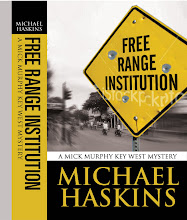
Michael Haskins

Tuesday, August 14, 2012

Learning to write . . .


I’m 100+ pages into my next Mick Murphy Key West Mystery and, because I’m writing it darker and differently than the other book in the series, it has been a lot of fun having past incidents threaten to change characters’ character.
I’ll be at a signing this Sunday, at Fast Buck Freddie’s Pop-Up Writers event on Duval and Fleming streets, in Key West, 6 – 8 pm, so if you’re on island for any reason, stop in and say hi. The event includes other Key West writers and the once popular store is being used as a Pop-Up art gallery, so there’s a lot to see besides writers.
Often, at signings or casual meetings with fans, writers are asked a few stock questions. How do you come up with ideas? When did you decided to be a writer? (By the way, btw for you tablet freaks, writing chooses you, you don’t choose writing). How did you learn to write? So, speaking for one, we have come up with stock answers.
Since I’m writing a sequel, I’d like to dwell on the last questions. How did I learn to write? It’s a many-sided question. I know there are great writers out there that went to Harvard and other colleges and learned to write there. Then there is a dwindling of old school writers that learned to write by being journalists, think Ernest Hemingway.

I had my feet in both ponds and I’ve often said I learned more from seasoned journalists while an office boy (not PC, but that’s what I was back then) at the Boston Record-American/Sunday Advertiser. Warren Walworth and the Gilhooley brothers taught me more about putting sentences together that would keep a reader reading than any college class ever came close to.

I should point out that I’m not talking about journalism today. Sadly, what existed in the ‘50s & ‘60s has all but died and it was the greatest school available to a kid who flunked high school English but loved books and writing.
So, you could say, my learning to write began back at the old newspaper with guys who drank too much, smoked too much and loved their work too much.
When I left Boston, I still loved to read. Reading is the best school for writers, since journalism is dying. What got me to thinking about this has a lot to do with what I’m writing now, tentatively titled “Key West Latitude.” My critique group of writers doesn’t like it, but it’s a working title and I can worry about a new title when the book is finished.
When I’m writing, or well into a book, I like to read other writers that I respect for their story-telling habits. I’ll read Robert Crais, Tom Corcoran, Don Bruns, James Hall, Bob Morris, Dennis Lehane or James Lee Burke. Well, as luck would have it, Burke has a new book out, “Creole Belle.” I began it and read it carefully, enjoying his prose and dialogue, as well as his plot.
Of course, I read many other writers but don’t waste my times on writers I don’t enjoy and there are a few of them out there too. I write mysteries, as we all know, so I read in the mystery-thriller genre. I read for enjoyment but also to learn and I learn a lot from Burke and the others. I learn what works and sometimes what doesn’t work. You read Burke’s Dave Robicheaux series and even if you’re stuck in a Montana snowstorm, you find yourself swatting at imaginary mosquitoes attacking your neck! He’s that good.
How do these writers do what impresses me? That’s what I try to figure out while wondering if whatever that is will work in my writing. Sometimes yes and sometimes no. But reading has taught me to try various things that impressed me.
Crais turning his Elvis Cole books into Joe Pike books gave me the idea of opening my book in progress from Norm’s voice. The book is darker and a sequel to “Stairway to the Bottom” and, if you’ve read it, the ending leaves Mick Murphy’s changed forever. I knew how I wanted to the new book to open but couldn’t see Murphy telling the story. Because I am a fan of Crais, I’ve read all his books and thought about changing POV. It took me a while to get it straight, believable, but once I did, I was off to the races.
If you want to write, you have to read and know why you like what it is you’re reading or what makes you dislike it. The good stuff you make work in your style, the bad stuff you try to remember not to use.
"Car Wash Blues" can be pre-ordered on Amazon and will be released the end of his month.

www.michaelhaskins.net

Thursday, June 7, 2012

Private Eye Writers of America's Shamus Award


I received an email from the editor of Ellery Queen Mystery Magazine to let me know that my short story, Vampire Slayer Murdered in Key West, is one of 5 stories up for the Shamus Award this October. Was I surprised!

The nice thing,  other than being nominated, is that the committee that chose my story is made up of fellow writers. The story appeared in the double Sept/Oct. 2011 issue of EQMM. If you have a copy hanging around, read the story.

It is an honor to be nominated and I am humbled.

Lee Goldberg's Mr Monk story is also on the list and Lee and I were friends back in LA before my move to Key West. I've sent Lee my best wishes.

Don't know what my chances are, but will be biting my finger nails until than.

Oh yeah, on the official website and other notices, my name is listed as Michael West, but I'm told the correction will be made. If I win, I hope they get the name on the award!

Just wanted to share the news. Now I can put "Shamus Award nominee" on my jacket cover and in PR releases. Hope it helps sales!

Sunday, June 3, 2012

Chris Knopf's ICE CAP

My friend and fellow writer Chris Knopf will release his new book, Ice Cap, in a few days and I thought I'd share chapter one and a review of two. I am sure you'll find them interesting.
 * * *
Publishers Weekly,

Ice Cap
Chris Knopf. Minotaur, $24.99 (304p) ISBN 978-1-250-00517-5
At the start of Knopf’s breezy third Southampton mystery featuring defense attorney Jackie Swaitkowski (after 2011’s Bad Bird), client Franco Raffini summons Jackie during a winter storm to the house of Tad Buczek, a relative of hers by marriage, who’s lying dead under a pergola. That Franco, previously convicted of manslaughter, admits he messed up the crime scene by moving the body only adds to Jackie’s doubts about his innocence. When Franco is arrested and charged with second-degree murder, Jackie is determined to win the case against her client, despite threats from a couple of toughs for her to lose it. A familiar cast aids her, including boyfriend Harry Goodlander, Sam Acquillo (the star of Black Swan and four other mysteries), and computer geek Randall Dodge. A host of Polish relatives (by marriage) and Tad’s imported wife, Katarzina, provide comedy and tragedy. Atrocious winter weather, Franco’s aversion to telling all, and Tad’s deep secrets keep the outcome in doubt. Whether Jackie or Sam takes the lead, Knopf’s ensemble mysteries are good entertainment.


Book Review: ICE CAP by Chris Knopf

Jackie Swaitkowski is an attorney practicing law in the Hamptons of Long Island.  Her client is accused of murdering her late husband’s uncle … and nobody wants to believe her client’s innocent.
The worst winter on record dumps endless snow on the Hamptons, which hampers our heroine’s attempts to discover who really committed the murder.  Of course, Jackie’s the only person who believes Franco Raffinni is innocent and she really has to work at it.  Also hampering her efforts to solve the mystery are members of her husband’s family and the Polish-American community in which they live, the victim’s widow, and emissaries of a local mob boss whose visits become increasingly more threatening and violent.
As a former resident of Long Island, I found myself skimming over the numerous references to the Hamptons; however, Jackie’s clever, witty, and entertaining personality MORE than made up for that minor flaw and I certainly didn’t skim anywhere else!  I laughed out loud numerous times as I read this book in one sitting.  Knopf does an excellent job writing from the perspective of his female character and I’ll be checking out more of Jackie’s adventures.
You shouldn’t miss this one.


Okay, now for chapter one!


Chapter 1

            It would have been the blizzard of the century if a bigger one hadn’t hit a few weeks later.  But for the people of the Hamptons marooned in the off-off season of mid-January, it was like we’d been plucked from the end of Long Island and dropped into the arctic circle. 
            For me, it was another opportunity to praise my Volvo station wagon, both steadfast and true, no matter how little maintenance or care I remembered to bestow upon it.  That evening the biggest challenge was identifying the car among the other giant heaps of rapidly building snow in the parking lot behind my apartment.  I was only out there  because I got a call from one of my clients, Franklin Delano Raffinni – an ex-investment banker who’d served time for killing his girlfriend’s husband with a rotisserie skewer before the husband could kill him with a steak knife.      
            “You gotta get over here, Jackie,” he said via cell phone, the words barely audible over the wind noise. 
            “Not the best time,” I said.
            “Don’t tell anybody anything till you get here.  I’m serious.  You’ll see why.”
            Another complicating factor was my complete lack of personal preparedness.  Snow was hardly unheard of in the Hamptons, but nothing like this.  The best I could do was cowboy boots, black leather gloves that went nearly to the elbow (bought for more heated circumstances), leotards, jeans, and lots of layers under my orange barn jacket. 
            I thought I’d overdone it until I hit the outside air and felt like the skin on my face was being cryogenically removed.  I found the car and dug my way to the driver’s side door with an old aluminum fry pan.  Inside the car somewhere was an ice scraper.  From the driver’s seat, I climbed into the back and dug the scraper out from under a stack of file folders, a pair of jumper cables, a box of Kleenex, a bird cage, a beach umbrella last used five months before, golf clubs never used and other unrelated items whose origins had been lost in the mists of time. 
            When I finally  finished clearing about two feet of snow off the car with the fry pan and scraper, another inch or two had already started to form.  The engine had been running, however, so the defrosters and wipers kept the glass clear.  The greater issue was the most fundamental – could I really drive in this stuff?
            Even if snow plows had been as prevalent in Long Island as they were in Buffalo, there was no way to keep up with the snowfall.  So the only choice wasn’t driving over, it was driving through. 
            At least  I’d been taught by my father how to handle a car in the snow.  He had his faults, but denying his daughter instruction in the many things he thought her too stupid to master on her own was not one of them.  So whenever a snow storm hit the area, however meager the accumulation, we’d venture forth in one of his ungainly American land yachts for a lesson, usually delivered in harsh and condescending tones, just to assure that even an effort to preserve my safety could be remembered with a tinge of hollow disappointment.
            The first trick was to go easy on the gas pedal, refraining at all times from spinning the wheels, a circumstance from which my father impressed upon me was virtually impossible to recover.  That day, I thought the whole thing was impossible, so I was more surprised than triumphant when I felt the car move forward out of the parking spot, across the lot and out into the street. 
            From there it was a short hop to Montauk Highway, the main east-west thoroughfare that connected a string of villages that comprised the Hamptons, and thus the only road the authorities were committed to keeping as clear as possible.  This meant that successive plow passes during the day had formed a small mountain ridge at the end of my side street.  As my father had taught me, this circumstance called for an opposing strategy: drop to a lower gear and hit the gas. 
            I felt it was every bit as unlikely that I’d be able to smash my way through a wall of snow as it was getting underway in the first place, which is probably why I didn’t consider the consequences of success until I found myself in the middle of Montauk Highway, perpendicular to the flow of traffic and directly in the path of a very large pickup.  I cranked the wheel hard to the right and kept power to the wheels, allowing me to spin the rear of the car into the opposite snow bank, just barely avoiding an ugly collision.  For its part, the truck swerved a few times, the edge of the yellow plow whispering past the side of the Volvo, and then swinging back into the mass of snow that entombed a row of cars along the curbside. 
            “Idiot,” I said to myself, for a variety of reasons, including the fact that I was now irrevocably lodged inside the packed snow. 
            I looked in my mirror and saw a woman in heavy coveralls, about the color of my barn jacket, jump out of the truck and slip-slide toward me through the swirling haze.  I rolled down the passenger side mirror and prepared myself for a well-deserved rebuke.
            “Are you alright?” she asked, looking anxiously through the open window.  Her long brown hair, streaked with grey, was salted with snowflakes, and her angular, dark face was lit up with concern.
            “I should be asking you,” I said.  “I did a really dumb thing.”
            “Everybody’s dumb in a snowstorm.  You stuck?”
            “Oh, yeah.  How would you feel about pulling me out?”
            “I’d feel fine about it,” she said.  “Don’t go anywhere till I get back.”
            She jogged back to her truck, jumped in, did a three-point turn and drove a short way past me.  Then she got a chain out of the truck bed and hooked us up.  She gestured for me to roll down my window again. 
            “Just help me along with some gentle acceleration.  No stunt driving necessary.”
            “What’s your name?” I asked.
            “Dayna Red.  I tell people it’s a house paint.  Nobody believes me.”
            I told her my name and profession – counsel to the region’s impoverished miscreants, or merely misled, one of whom had sent me an urgent call, which I felt irresistibly compelled to answer. 
            “Not in this weather you aren’t,” she said. 
            “What if I hired you?” I asked her.
            “Plow job?”
            “Escort.  I need to get over to Seven Ponds in Southampton.”
            She leaned into the car, bringing some more of the storm with her.  A white dust started to form on the accretion of papers, soda cans and empty cigarette packs that filled the passenger seat.
            “I just came from over there.  They haven’t plowed yet.”
            I wrote the address on a handy piece of paper.
            “You know where that is?” I asked her.
            She studied the paper. 
            “Sure.  Tad Buczek’s place.  Metal Madness.”
            Metal wasn’t the only thing mad about Tad, but it figured largely.  Like my late husband’s family, the honorable Swaitkowskis, Tad’s family had made the calculation that tens of millions of dollars in hand from real estate developers was better than bushels of potatoes you had to go to the trouble of growing, harvesting and selling into a saturated market.  Tad’s share of the bounty was substantial, enough for him to retain fifteen acres of mixed fields and woodlands for himself, on which he established one of the more irregular local homesteads, even by the rigorous standards of the Hamptons. 
            Always a connoisseur of large agricultural  machinery, Tad harnessed  his new wealth to embark on a major acquisition program, focusing on earth moving equipment, until his property was littered with backhoes and bulldozers, excavators, dump trucks and articulated haulers.  Zoning disputes quickly erupted, led by some of Tad’s new neighbors, the wealthy owners of colonial-style and post modern mini-mansions that rose up out his family’s former potato farm.  
            Tad eventually reached a settlement, that in my former life as a real estate lawyer I helped draft, which required him to store his earthmover collection within a pair of huge pre-fabbed steel buildings, designed to enclose things like assembly lines and commercial aircraft.  The deal was sealed when he sited the buildings within a grove of pine trees deep inside the property, thus rendering the entire operation essentially invisible. 
            What his opponents hadn’t figured on was Tad’s purpose in acquiring the earth moving equipment in the first place, which wasn’t to simply warehouse a fleet of lumbering machines, but rather to apply them to the purpose for which they’d been originally engineered. 
            Moving earth.    
            The land cleared of the offending eyesores was soon in the midst of a massive transformation.  Out of acres of flat, unobstructed potato fields grew huge hills, plateaus, pyramids and berms that circled into themselves like ancient fortifications.  Much of this required massive infusions of fill, which meant a steady procession of dump trucks importing sand, gravel and rough soil from as far away as North Jersey. 
            Another flood of lawsuits resulted, but there was little the neighbors could do about this one.   There was no law or statute prohibiting the physical alteration of a person’s private land, provided it had no negative impact on the adjacent environment, water supply or septic systems.  Offenses Tad studiously avoided.
            Better yet, the work was done in fairly short order, barely six months, after which Tad set to growing grass and planting trees and bushes on his freshly terra-formed estate, softening the edges of the artificial earthen shapes until they took on the character of a naturally molded landscape, one of such verdant beauty that any complaint seemed fatuous at best.
            The subsequent good will helped Tad weather the next explosion of outrage.

#   #   #   #  #   #  #   #  #    #

            “I’ll  have to put the plow down when we turn on David White’s Lane,” said Dayna, after pulling me out of the snow bank and walking back to my car.  She asked for my cell phone number.  “I’ll call you and we’ll keep the connection open.  Keep it on speaker.  Better than a walkie-talkie.”
            The snowfall might have abated some as the sky above darkened to a deep, sooty grey.  But snow still filled the air, blown into a chaotic frenzy by the increasing wind.  That was one of the costs of living close to the ocean.  Whatever lousy weather you could have out here, the wind always made it that much lousier. 
            Almost a half hour later we reached the intersection of Montauk Highway and David White’s Lane.  I asked her to give me a few minutes to clean the ice pack off my wipers and the congealed snow and road grit out of the grill.  It took longer than I hoped, hampered as I was by icy needles being driven into my face.  I knew there were buildings on three corners of the intersection, but now with night completely settled in, they only looked like ghostly shapes within the blustery haze.  I made it back into the car thinking it may not ever be safe to emerge again.
            “They’re saying it’s the blizzard of the century,” said Dayna over my exotic new smart phone, a type that provides everything short of teleportation.  “Could get three feet, not including drifts.  The governor’s shut down the whole island.  Non-essential travel’s forbidden.”
            “Sorry if this gets you in trouble.”
            “I’m essential, honey.  Which means you’re also protected.  It’s like diplomatic immunity.”
            “I know the cops around here pretty well,” I said.  “Good luck with that one.”
            Even with her heavy four-wheel-drive truck, knobby tires and snow plow it was slow going.  Every so often the load in front of the plow grew so large she had to increase the angle of the blade and shove it off to the side.  Then we’d back up a little and take off again, her easing along what she hoped was the road surface, now completely obliterated by a blanket of deep snow, and me transfixed by the two red lights on her tailgate and the pale light over the truck’s license plate, which read “Wood Chick”.
            I never would have made it without her.  No way, no how. 
            “Wood Chick, you’re the aces,” I told her over the phone, deciphering the vanity license plate, WOODCHIK .
            “Now I’m embarrassed.”
            “Don’t be,” I said.  “I’m just trying to be nice.”
            “My own fault for plastering that name right on my ass.  With encouragement from people I’d be better off ignoring.”
            “I know people like that.”
            “Tad’s place is getting closer,” she said.  “During the day we’d have a visual by now.”
            She meant we could have seen one of the towering metal sculptures that comprised the loony installation Tad had created and named Metal Madness.  The sculptures,  mounted atop Tad’s ersatz mountains, were built of twisted sheets of steel welded into abstract shapes that thrust high into the sky.  And consequently, the latest cause for neighborhood angst and costly legal maneuvering, which I was grateful to leave behind, safe within my current career as a full-time criminal attorney.
            Seven Ponds wasn’t even a place name, it was just a few roads of the same or similar names that criss-crossed a semi-rural swath north of Southampton Village.  And by my reckoning, there was only one pond named Seven Ponds, which must have been either an act of clever misdirection, or the imaginative product of some ancient real estate broker. 
            These days I’d call the area mixed use, with farms like Tad’s mostly developed, and the remaining open land, preserved in land trusts, slowly succumbing to natural re-forestation.  The few auto repair shops, roadside markets and tractor dealers from back in the day had also taken on a disintegrating, superannuated hue.
            Tad’s place was at the northernmost limit of that area, describable as the foot hills of a little forested ridge that ran down the spine of the South Fork. This meant that Dayna and I had a hard fight up a relatively modest grade, with lots of starting and stopping, punctuated by fruitless spinning of wheels, just as my surly father warned me against.
            “A little less torque might help,” I said to Dayna over the phone.  She grunted and proceeded slowly, but relentlessly, with or without my advice.  I followed in the same spirit.
            After what felt like hours, because it almost was, we finally reached the head of the driveway that led into Tad Buczek’s place, heralded by the words “Metal Madness” punched out of a slab of aluminum hung above the entrance. 
            “At least it’s downhill from here on,” said Dayna, after making a tentative run at the top of the driveway.  “You ready?”
            “I’ve waited all my life.”
            “I could chain us together again, which might keep you from getting stuck, or just pick my way along in the hope you can keep a safe distance and stay under way.”
            “That’s what I’ve been doing,” I said.
            “This is different.  There’re no road markers.  I’ll be driving blind.”
            “Unchained sounds more like me,” I told her.
            “Okay.  Here we go.”
            Dayna dropped the plow and turned into the driveway.  It was the deepest snow  yet encountered, undisturbed by traffic of any kind.  I could see all four wheels of the pickup throwing up tiny wakes, half-spinning, half digging in.  It wasn’t a slow passage – Dayna needed the velocity to attack the heavy snow, some in drifts that crested over the top of the plow. 
            “Are we headed to the house?” she asked over the cell phone.  “If so, we’ll have to make a hard left very soon.”
            “Let me make another call and I’ll tell you.”
            I hung up and tapped Franco’s number from the list of recent calls.  It rang a few times before he picked up.
            “I see two sets of lights,” he said.  “Is that you?”          
“It’s me and a plow.  Where are you?”
            “In front of the big pergola.  Tell the plow not to run me over.”
            I hung up and did just that.  I told Dayna the pergola was half way between the upcoming left and the main house.  She said “Roger that,” and slowed down to take the left.   I crept up behind, praying I had the momentum to stay stuck to the slippery road surface and still make the turn. 
            We both made it around, and I saw the lights mounted above the truck’s plow kick up to high beams.  I tucked up closer to her rear bumper, feeling more secure at the slower pace she’d chosen.  It was still fast enough to cause the snow to explode out from the front of the truck and wash into me from either side and above.  My windshield wipers, already compromised, soon surrendered, and I picked up the phone to tell Dayna I had to stop when I heard her voice over the speaker. 
            “There’s a guy waving at me,” she said.
            “Stop there.”
            She actually drove a little past him so he was at my passenger side door when I stopped.  I rolled down the window.
            “So Franco, what up?”
            I assumed it was Franco based on the prominent nose and thin black moustache and goatee, which were the only identifying features.  The rest was snow-covered wool coat and baseball cap.  When he greeted me, in his Italian-inflected English, more a lilt than an accent, I was sure it was him.
            I got out of the car, and stumbled around to the other side.  Dayna approached and asked if I was alright.  I introduced the two of them and they peeled off their gloves to shake hands.  Franco gave a neat little bow. 
            “Jackie, I need to show you something.  Ms. Red, you better wait here, if you don’t mind.”
            “I’d rather come,” she said.
            “She can come,” I told him, not knowing exactly why.  I had nothing to fear from Franco, but you quickly grow connected to people, even strangers, who deliver you through dire circumstances.   I wanted her nearby.
            “Suit yourself,” he said, turning and then tromping under Tad’s giant pergola through the deep snow, guided by a bright flashlight, made less so by the tiny snow flakes that streamed down through the woody vines and open beams of the structure above.  I cursed the lack of a hat.  
            It wasn’t a long walk, blessedly, as I quickly grew weary of the trudge, a misery compounded by the slippery soles of my cowboy boots.  We were at the far end of the pergola, in an area that was partially covered by a hard roof under which Tad had a wooden table for al fresco dining.  On top of the table was a long, white mound, at the fringes of which I could see the edge of a blue tarp.  Franco waited for us to come up to him, then took a piece of the tarp in his gloved hand.
            Dayna said “Uh-oh,” under her breath. 
            “You wanted to come,” Franco said to her, then flipped the tarp over the mound, sending the covering snow flying into the air, where some of it was blown back, hitting me in the face.  I wiped my eyes and followed Franco’s flashlight as it outlined the prone figure of a large man, finally stopping at the red and grey mash that used to be the defiant and hard-headed skull of Tadzio Buczek. 
                       

Ice Cap becomes available as of June 5. Order it now at your local bookstore!

Michael Haskins


Tuesday, May 22, 2012

"Cliff Walk" by Bruce DeSilva

My friend Bruce DeSilva's second Liam Mulligan crime novel is out and getting rave reviews.


Publishers Weekly gave it a coveted starred review, saying, "Look for this one to garner more award nominations." Booklist also gave it a starred review, calling the plot "exquisite" and saying it is "terrific on every level."

One again, the story revolves around the tumultuous life of Liam Mulligan, a wise-cracking investigative reporter for a dying Providence, R.I., newspaper.  As the tale opens, prostitution is legal in the state (which it really was until two years ago.) Politicians are making a lot of speeches about the shame of it, but they aren't doing anything about it. Mulligan suspects somebody is being paid off.

As he investigates, a child's severed arm is discovered in a pile of garbage at a local pig farm. Then the body of an internet pornographer turns up at the bottom of the famous Cliff Walk in nearby Newport. At first the killings seem random, but as Mulligan keeps digging, strange connections begin to emerge.
Promised free sex with hookers if he minds his own business--and a savage beating if he doesn't--Mulligan enlists the help of Thanks-Dad, the newspaper publisher's son, and Attila the Nun, the state's colorful attorney general, in his quest for the truth. What he learns will lead him to question his long-held beliefs about sexual morality, shake his tenuous religious faith, and leave him wondering who his real friends are. Cliff Walk is at once a hardboiled mystery and a serious exploration of sex and religion in the age of pornography.

Saturday, April 28, 2012

MWA 2012 Edgar Award Winners


Mystery Writers of America is proud to announce the winners of the 2012 Edgar Allan Poe Awards, honoring the best in mystery fiction, non-fiction and television published or produced in 2011. The Edgar® Awards were presented to the winners at our 66th Gala Banquet, April 26, 2012 at the Grand Hyatt Hotel, New York City.
 
 
BEST NOVEL

Gone by Mo Hayder (Grove/Atlantic – Atlantic Monthly Press)


BEST FIRST NOVEL BY AN AMERICAN AUTHOR

Bent Road by Lori Roy (Penguin Group USA - Dutton)


BEST PAPERBACK ORIGINAL

The Company Man by Robert Jackson Bennett (Hachette Book Group – Orbit Books)


BEST FACT CRIME

Destiny of the Republic: A Tale of Madness, Medicine and the Murder of a President
by Candice Millard (Random House - Doubleday)


BEST CRITICAL/BIOGRAPHICAL

On Conan Doyle: Or, the Whole Art of Storytelling by Michael Dirda (Princeton University Press)


BEST SHORT STORY

 “The Man Who Took His Hat Off to the Driver of the Train” – Ellery Queen Mystery Magazine by Peter Turnbull (Dell Magazines)


BEST JUVENILE

Icefall by Matthew J. Kirby (Scholastic Press)


BEST YOUNG ADULT

 The Silence of Murder by Dandi Daley Mackall (Random House Children’s Books – Knopf BFYR)


BEST PLAY

The Game’s Afoot by Ken Ludwig (Cleveland Playhouse, Cleveland, OH)


BEST TELEVISION EPISODE TELEPLAY

 “Pilot” – Homeland, Teleplay by Alex Gansa, Howard Gordon & Gideon Raff (Showtime)


ROBERT L. FISH MEMORIAL AWARD

"A Good Man of Business" – Ellery Queen Mystery Magazine
by David Ingram (Dell Magazines)


GRAND MASTER

Martha Grimes


RAVEN AWARDS

M is for Mystery Bookstore, San Mateo, CA
Molly Weston, Meritorious Mysteries

ELLERY QUEEN AWARD
                                                                                          
Joe Meyers of the Connecticut Post/Hearst Media News Group

**********************

THE SIMON & SCHUSTER - MARY HIGGINS CLARK AWARD
(Presented at MWA’s Agents & Editors Party on Wednesday, April 25, 2012)

Learning to Swim by Sara J. Henry (Crown Publishing Group)


# # # #
The EDGAR (and logo) are Registered in the U.S. Patent and Trademark Office by the Mystery Writers of America, Inc.


Tuesday, April 10, 2012

Know your guns before you put them in your protagonist's hands

The recent news headlines out of South Florida got me to thinking about handguns. I am an endangered species in that I am a liberal Democrat that supports the right to own guns. But that’s for another time. This time I am thinking about the reality of guns and what they do and what they sound like and what they feel like when shot, when empty, when loaded and how the writer has a responsibility to portray that in his/her writing.
As a writer of mysteries, there’s a lot of guns used in my books and stories. I am fortunate to have a trained military intel person, as well as police  and deputy sheriffs to go to for help and they often points out my errors.
“But I saw it on TV,” or “That’s what the website said,” are usually two of my stock comebacks.
When I moved to Key West onto my sailboat, from smoggy Southern California, I sold or gave away my few guns since there was no local gun range and not much room on Mustard Seed.
About two years ago, The Big Coppitt Gun Club opened and I have taken advantage of it for shooting and the owner’s knowledge of guns, as a backup source. I now have a few handguns that often appear in my books and when my characters shoot them, I know what I’m writing about.
There are things I write about that are the result of research and corroboration. The firing of guns is more personal than racing a car at 100 mph on US1, even if it’s a replica of the car Steve McQueen used in Bullet. If you can race the car, do it. If you can’t, find someone that has. A Monroe County Deputy Sheriff would be a good place to start, since most of US1 is 45 mph and in a few places 55 mph. I have chapters of that event happening on the seven-mile bridge, in “Car Wash Blues,” due out in August from Five Star. Someone I know really did it and we talked. I won’t drive with him!
Anyway, my point is, if you use guns in your story and, especially, if your protagonist is not a law enforcement officer, you should know how he/she feels when pulling the trigger; and I don’t mean about shooting someone. A frail 80-year old man isn’t going to shoot a .45 cal automatic without some consequences. An inexperienced 18-year old isn’t going to shoot the .45 and not be surprised (as well as miss his target) at the kick.
Learn a little about the various caliber handguns and find the one that fits your protagonist. On the other hand, what about all the other people in your stories that use guns? Not everyone uses the .45. My preference is the 9mm Sig Sauer, but my array of good guys and bad guys use revolvers as well as semiautomatics in other calibers.
Glocks, Sigs, Colts, Rugers, there’s no end to the number of handguns on the market and you should know which one will work for you character and some of its traits. Knowing the reputation of a certain brand will keep you from using a cheaply made replica of a Glock in your writing and know what caliber your gun is. Many come in a variety of calibers. Glocks come in 9mm, 40 cal & 45 cal. The Sig has a model that can switch between 9mm and 40 cal with little effort.
Did you know that Glocks and Sigs don’t have safeties? Their trigger pressure is higher than a Ruger, which has a safety. With the safety off, the Ruger requires very little trigger pressure to shoot. Glocks and Sigs require more trigger pressure to shoot. Good to know this, if there’s an physical altercation while one or more people are holding a handgun. Being knowledgeable about guns will make your story more honest and gun buffs less likely to write and explain why what you did couldn’t be done!
Do you use a real city or town in your stories? If you do, you’d better know what weapons the police or sheriff’s department issue to its officers. If you get it wrong, someone will let you know and you may have lost that reader because of your inaccuracies.
The military has a 20mm cartridge that is used in fighter jets. It will penetrate certain items, such as a boat hull, and then explode like a grenade. A couple of countries make sniper rifles that shoot the cartridge. Capacity is three-round magazine and the rifle has to be on a tripod because its recoil is so strong. Lots to know. Now, I didn’t get to shoot a 20mm round, but my military intel guy got me specifics and there were videos on the internet! The bad guys use this 20mm sniper rifle in “Car Wash Blues.”
If you alreadyuse the web for research, it’s no surprise what is on there. Check out the DEA, CIA, JIATF, JSOCK and you’ll be surprised at what you find. I was! And you thought it was all secret stuff. If you find something on the weaponry your protagonist is using, keep checking, and double check your checking. The web is as good as any place to begin your research into handguns and rifles, but don’t stop there, go to the experts.
Okay, your protagonist carries a 9mm Sig. In what? Stuck in the back of his pants like all the good guys do on TV? Get a Sig, not mine, sorry, stick it between your belt and backbone and make a mad dash down the driveway and see what happens. Looks good on TV, but unless you’re using  the right holster the gun is gonna drop on the ground. How heavy is it to just fit between your belt and back and not be a bother? Try it and find out.
For ladies, a gun in the purse is useless. Well, it gives the perp a weapon once he/she has your purse, but that isn’t your purpose. Maybe in could be in your story.
Women I know like the ‘pocket’ guns. Usually a .32 or .380 semiautomatic. It’s small, light and, as it says, it fits into your pocket. If your female protagonist wears dresses or skirts all the time, I don’t know what to tell you. Find an ankle holster that will adjust to her thigh. Who knows, maybe they make holster for that.
To help make a short blog longer, let me tell you of my mistake in “Free Range Institution.” Thankfully, it was caught by my military intel guy.
I’d read and seen TV news reports on scooter assassins in Colombia and how Pablo Escobar used them to kill his enemies. I brought a drug gang to Key West in "Free Range Institution" and in an attempt to kill Mick Murphy they use two scooter assassins to chase him, Tita and two military men through old town.
I forget the weapons I chose for them, but when the chapters came back from my source, he’d written “would topple scooter.” I called him. He explained and I went with his suggestion of using an Uzi because all you need to do is point and shoot. The Uzi will spray 30-rounds instantly and that makes it a good scooter-assassin’s weapon. It also comes with magazine holding up to 50-rounds. Point and shoot!
We write mysteries and we kill people. Do it right! Get experience, talk to experts – I don’t suggest you murder your neighbor or significant other, but do suggest real research on the matter.
Most gun ranges rent weapons and have a knowledgeable staff. Tell them you’re a writer, and you need to find the right weapon for this or that, and you might be surprised how helpful they are. Everyone likes to feel like an expert and the go-to person for a writer. Believe me, it works.
Get a feel for the weapons in your books. Discover why gun ranges – indoor like mine or outdoor like my intel’s in NC – make you wear ear protection. Once you’ve become familiar with the feel and sounds, next time a TV or movie shows an indoor gun fight, even only a few shots, and then everyone is talking about something you’ll find yourself thinking, “man, they’d be deaf as a rock after that.” You don’t want your readers saying things like that about you.
This is between us, so keep it under your hat. My military intel guy is going to be the guest speaker at the May 19th Mystery Writers of America, Florida Chapter’s luncheon. That’s what he told me this past weekend when he was in town. We discussed his talk and believe me, it’s going to be interesting. He mentioned that when he got into the intel side of the military, fiction was way ahead with its ideas. Today, he says the intel agencies are waiting for fiction writers to catch up! He has some great stories, but I’m just glad he’s not writing fiction!
Bonus question: what’s a clip and what’s a magazine. Which goes where.
It’s a common error in books, TVs, and movies. Do you make it? I did, once!
My books are available on Amazon.com, the Kindle Store, or at my website: www.michaelhaskins.net.

Friday, March 30, 2012

Echoes of Savanna & Raven's Song


My friend and fellow author, Lucinda Hawks Moebius, has some nice things to say about Key West, my home,and it says a little about her life too.  But the  important things she has to say are about her two books. Please take the time to discover this writer.
Michael 

Thank you for hosting me on your blog.  To tell you the truth, I am extremely envious of you right now.  I can just imagine you sitting on the beach, a sun hat shielding your eyes, sipping a sweet drink, the kind with a little umbrella and a wedge of pineapple as a garnish, and watching a beautiful sunset.  I love the beautiful artwork of the sun as it rises and sets on the horizon.  
  
There have been times in my life when I have been on my way to work and I have just had to stop and drink in the sunrise.  One day I stepped out of my little car and glanced over my shoulder.  The sky was almost a translucent blue and the soft clouds were painted the beautiful orange-red you almost never find in an artist pallet. I had to stop and just watch as the colors shifted and deepened to the soft orange and pale blue of early morning.  It took my breath away and allowed me to start my day with the warmth and beauty of morning in my heart. The sun’s constant circle reminds us to cherish each moment, love the little things, and find beauty in the world. 

One of my favorite memories of my grandmother was sitting on the front porch of my childhood home and watching the sunset. We had pulled up two chairs and relaxed as we watched the light blue sky slowly turn pink, orange and red. The clouds floated across the sky like puffs of smoke slowly painting the horizon. Nothing can compare to the awe and silence a perfect sunset can bring to my heart. My grandmother and I didn’t speak for the entire time the sun was going down. We didn’t need to, the sunset said everything that needed to be said. Every time I see a sunset I remember the time I spent with my grandmother and the perfect communication we had between God, nature and a woman and a child. Sometimes words are not necessary.

My grandmother was one of my biggest influences in my writing.  She always fancied herself as a poet and always wanted one of her grandchildren to become a published author.  I was nurtured on her love for the written word and her influence led me to study the craft and develop the skills to be a writer.  Even watching the sun rise and set was a lesson in writing.  It’s impossible to watch the sun make its journey and not want to put it into words.  Learning to put the images we see in our lives into words is one of the most important skills an author can develop.  In order to become better writers I think we should all spend more time watching sunsets.

I know I haven’t spoken much about me and my writing today.  I’m sorry if I am disappointing your readers by not telling them about my books and my life story.  I will provide you with the blurbs and links so your readers can see what I’m all about.  In the meantime I am going to check out a few travel sites and book some tickets to some tropical location where I can sip some fruity drinks under an umbrella and drink in the sunset.

Thank you for having me today
Lucinda Moebius

Echoes of Savanna:
Every generation has its defining moments, events that change history and turn the course of lives. Forever will the children of that generation be defined by those moments.
Savanna Taylor is a medical doctor in 2036, the same year terrorists release a series of plagues and viruses into the world. She is a nineteen year old Brain Trust whose task it is to find a cure for the diseases and develop vaccines to prevent their further spread. The world is thrown in turmoil and Savanna needs to find a way to survive with her sanity and family intact. She needs to find a safe Haven for herself and for those she loves.
Can Savanna cope in a world in constant flux brought on by war and disease? Can she save the world and protect her loved ones or will she make the ultimate sacrifice? How will she be defined?

Raven’s Song:
The next generation has come into its own.  Raven, Savanna’s impulsive, impetuous daughter has begun her own epic journey.

Raven was born in a time of turmoil and war.  She decides her calling in life is to be a soldier.  Sacrificing the shelter and security of Haven, Raven puts herself at risk to save others.  She finds herself in perilous situations and thrust into the role of leadership despite her own misgivings.  The Siren’s Song of Haven is continuously singing to her.  She could be safe, protected, sheltered and warm if she returned to Haven and its stone walls.  But, is it her destiny to live in the walls of Haven, or is there another destiny in store for this child of Haven?

About the author:
Lucinda Moebius grew up in the mountains of Idaho and Eastern Oregon. Her mother taught her to read when she was four years old and since that time books have been her constant companions. She has a Bachelor’s Degree in English Teaching, a Master’s in Educational Leadership and is currently pursuing a Doctorate in Education. Lucinda supports her writing habit by teaching High School and College. She currently lives in Boise, Idaho with her husband, stepson and their dog and cat.


Find me on facebook: Lucinda Hawks Moebius

FEEDJIT Live Traffic Map