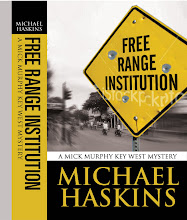
Michael Haskins

Sunday, February 27, 2011

Prove me wrong, please!

I had my first signing for “Free Range Institution” at Murder on the Beach bookstore last week and the attendance was better than I thought. I sold 14 copies of “Free Range Institution” and five trade paperback copies of “Chasin’ the Wind,” My first Mick Murphy Key West Mystery.

SleuthFest is only days away and I am on a panel about local in your story and moderate a panel about authors who are published by small presses. My publisher, Five Star, is a small press and it is my opinion that small presses are the only way for new writers to break in. There will be book signings after each panel for those involved and I hope to sell more books.

It is harder and harder to get an agent and/or publisher these days. The big bucks go to the writers on the NY Times bestseller list and with publishing in as much of a financial mess as everyone else, there’s little money left for unproven writers.

I look forward to my book tour that will take me to Houston and Los Angeles. I will be at the Los Angeles Times Book Festival with other MWA writers where I will be signing at the Mysterious Galaxy booth.

Then I have three signing that week. The first one at Book Carnival in Orange, Ca. then at the Flintridge Bookstore and Coffeehouse in La Canada, Ca., and finally at Mysteries to Die For in Thousand Oaks, Ca. If you are in any of these cities, or close by, please come in and say hi.

I look forward to these signings because I have my suspicions that this could be my last book-signing road trip. Not because I don’t want to do it, but book selling is a business now and not so much about the authors. Sales are important, and always have been, but the independent bookstores used to welcome all authors.

In NYC, one bookstore asked me to guarantee 30 book sales before they would host a signing. Hell, I hoped for 50 or 100, but guarantee – give me a break. Without being a draw of some kind, I think many authors will discover it is harder and harder to find stores willing to host signings.

I would love to be proven wrong.

Wednesday, February 16, 2011

Book Release: FREE RANGE INSTITUTION

Today, Feb. 16, is the release date of my 2nd book, Free Range Institution, in my Mick Murphy Key West Mystery series. I thought I would share some words from those that got to review the book prior to today. If the reviews pique you interest, please buy the book at an independent bookstore or go to my website - www.michaelhaskins.net - and I list a few of my favorite bookstores and they take internet orders. All bookstores need our support.


EARLY REVIEWES OF

“Free Range Institution.”

Booklist Review (January 1, 2011)

This title will publish in February 2011

****************************************

Free Range Institution. Haskins, Michael (Author)

Feb 2011. 382 p. Five Star, hardcover, $25.95. (9781594149290).

Mick Murphy, the news hawk hero of Haskins’ latest Key West mystery, makes a classic reporter goof. He pretends to be a little closer to the action than he really is. Both good and bad guys take him at his word, and the chase is on. At the heart of it all is a plot to bring a particularly cheap and addictive drug called paco into the U.S. As the good guys assemble behind Mick and check their guns, echoes of Miami Vice reverberate, with both its pastel glitz and its underlying despair. The cartels have more money and guns; the best the rest of us can do is hold together. Things get lively as the confrontation approaches, but this really isn’t a high-concept action novel or even a stripped-down thriller. It’s about adult relationships, and its generous use of the Key West setting will appeal to readers who like local color. Since it’s the Keys, a lot of beer and rum goes down, and there’s much eating of cheeseburgers, dolphin sandwiches, and breakfast eggs with hot sauce.

Don Crinklaw

Mark Howell

Editor

Solares Hill

It’s a very different book from Haskins’ first Murphy novel. Not simply in length but in range of characterization. I truly like all of these people – Jim, Norm, Tita (when do I get to meet her?) and, naturally, the Padre and Murphy himself. Also the plentiful bad guys and the two top cops . . . they come across as all too real. There’s an almost Felliniesque display of characters here and I think that’s what will keep readers engaged through quite a heavy plot – not just the plotting but the bad guys’ plot in itself.

There’s also a most vivid description going on. Despite the legally required name changes, which I actually enjoy, the scene setting is evocative throughout. It’s one of Haskins trademarks - although not overdone, strangely it’s extremely simple, no overwriting.

Let me tell you this: Like in many compelling novels, the opening scene is perhaps the most compelling in the whole book, driven by a dream-like experience of that falling body, plus the falling hat, and the subsequent reactions and police activity. I was there - and still am.

And if I was a reader who’d never, ever been to Key West, the scenes that follow, especially the one on the hotel roof with its view over the harbor and all the scurrying below, those scenes would have brought me to town on the very next ticket. Totally compelling.

Finnegan’s, the Hog’s Breath, the Schooner Wharf, the rant about the Churchills . . . There’s so much in “Free Range Institution” that it kept me up all night reading.


International Thriller Writers

February Review

Leighton Gage

Free Range Institution

Mick Murphy’s Return – and Michael Haskins’ Secret

Good news! Mick Murphy is back.

I was introduced to Mick back in 2008, (that was in Chasin’ the Wind) and I’ve been chasin’ a sequel ever since.

Now, finally, in February of 2011, author Michael Haskins, is giving us one.

It’s called Free Range Institution.

Mick, for those of you who haven’t met either one of them, bears a striking physical resemblance to his creator.

They both smoke cigars. They both drink Jameson Irish Whiskey. They both have beards – Haskins’ is salt-and-pepper, Murphy’s is red. They both wear Boston Red Sox caps.

Michael is a colorful and interesting character to write about, but he lives in Key West most of the time. And, unlike Mick, he never disappears for three years in succession. So, even though Key West may be off the beaten track for many, it’s still a heck of a lot easier to catch up with Michael than it is to catch up with Mick.

Let me then hold forth, in the first instance, about Mick. Who, I hope, isn’t going to keep us waiting quite so long before he relates his next adventure.

Yeah, that’s right. Mick tells his own stories.

The books are written from the point-of-view of Liam (nicknamed “Mad Mick,” or simply “Mick”) Murphy, a journalist and a sailor.

Hey! Michael Haskins is also a journalist and a sailor. But I’m talking about Mick. Or am I? Sometimes I get confused.

You would, too, if you had the experience I had a few months ago.

It was like this: I was in the ‘States for a short visit. A friend of mine and I decided to drop down to Key West for a day and, while there, visited Michael. He’d just received some ARCs of Free Range Institution – and was kind enough to gift me with one. (Actually, he didn’t have much of a choice. Remember I mentioned Michael is a sailor? Right. Well, as such, he has considerable upper-body strength. But there were two of us, and my friend held him down while I twisted his arm.)

But I digress.

I didn’t get a chance to crack open Free Range Institution while I was in Key West, because even more important things, like drinking, got in the way. But, as we made the rounds of the bars, Michael kept introducing me to his friends, of which he has many. I confess that I remember some of the faces better than others. The ones I met earlier in the evening being the ones less-blurred, but I can still recall most of the names.

And guess what? They’re all right there, in Free Range Institution. Bill, Karen, the lot. They are all right there.

I always wondered how Michael Haskins was able to write with such verisimilitude about Key West and the people who live there. But that was back when I thought he was inventing all of those characters.

Now I know different.

Michael Haskins’ secret is that almost all of those people really exist. They’re friends of his, neighbors of his, people he knows, people he likes, even people he doesn’t like. All he does is string the words together to describe them. (Note to people who aren’t authors: Stringing words together is something you might not find as easy as I make it sound.)

Oh, yeah, every now and then Michael takes some artistic license with his character development (like with a certain priest in Free Range Institution whose persona will haunt you – and I use the word haunt quite judiciously). But he reserves his major firepower for his plots.

And the word firepower is also used judiciously.

Free Range Institution is chockablock with action on the land and on the sea. Colombian drug lords, crooked DEA agents, evil politicians, undercover cops, they’re all there - and all shooting it out with each other.

I doubt there has been more blood spilled in that little town since the days of Commodore David Porter, who back in the early 1820s, ran his anti-pirate squadron out of Key West. (Footnote: Porter, like Michael and Mick, was born in Massachusetts. Isn’t that bizarre?)

Ever heard of the dangerous and highly-addictive drug paco? I hadn’t. You will, if (did I say if? I meant when) you read Free Range Institution. It’s the illicit importation of that paco upon which Michael hangs his engaging plot.

The title? Oh, yeah, that’s from a song written by Scott Kirby. Michael reproduces these lyrics at the beginning of the book:

I’m living in a free-range institution

It’s a three-ring circus with twelve-step programs to choose

from

An open-air asylum at its best

Your shrink says you need a little sun and rest

Baby, check yourself right in to Key West

Rest? Fat chance! You’re going to get precious little of that in Michael Haskins Key West. Free Range Institution is non-stop action – and guaranteed to keep you up all night.

Leighton Gage is the author of the Chief Inspector Mario Silva Investigation series set in Brazil. His fourth in the series, Every Bitter Thing, came out late last year. Gage has his home in Santana do Parnaiba, Brazil, and also travels frequently to the Netherlands and Florid.

THE MYSTERY GAZETTE

TUESDAY, JANUARY 4, 2011

Free Range Institution-Michael Haskins

Free Range Institution
Michael Haskins
Five Star,
Mar 9 2011, $25.95
ISBN 9781594149290

Reporter Liam “Mad Mick” Murphy and attorney Tita Toledo go to lunch on what each hopes will prove a romantic interlude. Instead they watch Murphy's waterfront pal
Jay Bruehl dive off the roof of the six-story Hotel Key West. A notorious snitch, the late Bruehl recently informed Murphy about a big drug deal. The Hotel Key West happens to host Colombian traffickers discussing importing deadly low-grade cocaine though the Keys.

After gaining entrance to the drug meeting, undercover cop
Rebecca Connelly vanishes. Padre Thomas Collins claims angels informed him where Connelly is being held. They find her battered corpse at the locale the priest said she could be found. The federal, state and local law enforcement officials and the drug cartel target Collins and Murphy. Soon Key West becomes a graveyard as violence turns the Caribbean into a red sea.

The second Mad Mick Key West thriller (see Chasin' the Wind) is a wild over the top of Solares Hill (make that the proposed Miapolis) as once again readers will wonder what is the difference between the good and bad guys as neither seems concerned with collateral damage. The story line is fast-paced with more bullets flying in the
Conch Republic than Al Capone ever authorized in Chicago as mad Mick lies to authorities to get the story and obtains reinforcements from a horde of souls even crazier than he is. Fans who ignore plausibility and appreciate that death has become a local growth industry will enjoy the Free Range Institution gunfight at Key West.


Blurbs from the book jacket

“A masterful tropical mystery. Every city has an ugly underbelly populated with bad guys—even touristy Key West. In Michael Haskins’ deft storytelling, this tip-of-Florida isle—literally at the end of the road—is equal parts paradise and murderous mayhem, one made all the more exciting by his hero, Boston Irishman Mad Mick Murphy.”
W.E.B. Griffin &
William E. Butterworth IV, Wall Street Journal and New York Times #1 bestselling authors

“I've seen some crazy things in Key West, but Michael Haskins' Free Range Institution beats it all. People leaping from buildings, and hanging from trees...angels who tell the future and enough drugs and corruption to destroy the entire Key. Try to keep up, because things happen at breakneck speed!”

Don Bruns

Award winning author of

Stuff To Spy For, Stuff Dreams Are Made Of, Barbados Heat, Jamaica Heat

“I’ve had the privilege of spending a month during each of three years on Key West. Michael Haskins has lived on the Rock for more than a decade and like most non-natives who become reporters for local newspapers, he’s absorbed more island life and lore than most. FREE RANGE INSTITUTION is a wonderful new entry in his Mick Murphy mystery series. Happily for those who love Key West, FREE RANGE INSTITUTION is both a terrific ride through, and a terrific read about, the people and places personifying America’s beachhead in the ‘North Caribbean.’”

Jeremiah Healy,

author of RESCUE and SPIRAL

“Imagine . . . cocaine cowboys, side street shootouts, big city crimes in small town surroundings, fallen angels, a chain-smoking priest . . . corruption . . . greed . . . murder . . . covert operations . . . with journalist Mad Mick Murphy reporting. Michael Haskins’ narrative makes us comfortable in Key West . . . before he roars through the island like a Tropical Hurricane. It’s a perfect storm.”

Steven M. Forman, author of

Boca Knights and Boca Mournings

“I'm hooked! Mad Mick Murphy is a quixotic character in an exotic setting. Key West offers him crimes to solve, eccentric people to confound his journalistic ambitions, and life-threatening adventures to entertain readers.”
Shirrel Rhoades
Editorial Director
The Saturday Evening Post


Friday, January 28, 2011

MWA/CreateSpace/Kindle

I travel about 400-miles round trip once a month to attend the Mystery Writers of America, Florida Chapter, luncheon meetings in Deerfield Beach. The first 125-miles is along scenic US1 from Key West to Florida City and then I pick up the Turnpike north to Sample Road, cut across to I-95 and an exit or two later get off. Without delays, it’s an easy four hours.

I do this not because I am on the chapter’s board, but for the camaraderie of other writers. In fact, I accepted the board nomination so it would be one more excuse to attend the meetings. Sometimes it can take an extra kick in the pants to get on the road at 6 a.m. to make the 10:30 board meeting. On the months there is not a board meeting (few) I can leave at 7 a.m. I have my pit stops, but once I am on the Turnpike it’s pretty much keep going. I pick up my coffee – extra espresso shot – at Starbucks just before the Turnpike and I am off.

I mention this because people have the misconception that Key West is a writers’ paradise. It is my paradise, maybe even my muse, but not too many writers hangout. If they do, they keep pretty much to themselves in cliques or quietly avoid people. They may come to Key West to write and need the solitude – kind of like a person needing AA showing up to attend meetings at our Bahama Village AA club house – but to many of us that live here, solitude is not what we came here for.

MWA is a fantastic organization – www.mwaflorida.org – and I became a member in the early ‘80s when I joined the SoCal chapter. I think the thing that stands out to me is that the most successful writers are willing to advise unpublished writers and I would even say they expect to be approached at these luncheons and conferences by struggling writers. They try to answer all the questions, no matter how lame and I know because I am guilty of asking some pretty lame questions in my day. I cannot think of anyone I ever approached that was rude on condescending – encouraging is the word that comes to mind.

If you think about, it is really amazing because as the publishing world shrinks, agents become elitists, and more and more people try to become writers, we are all competitors. When my book – Free Range Institution – comes out later this month, it competes with all the other books on the shelf in stores. I realize I am no real competition to the NY Times bestseller list of writers, but believe me there are a few more published writers out there that never make it onto that list and it’s not because those on the list are better writers.

After these luncheons any number of the guests – writers and fans and friends – can usually be found at the hotel’s bar (surprised?) sitting around and discussing – can you guess what? Yeah, ok, you are smart. We discuss writing in it may various forms.

If you follow this blog, you know that Mike writes a lot about self-publishing and his successes. I had some questions for him because my first book – Chasin’ the Wind – is on Kindle. Sandy Balzo, a writer with two series going (she has no time for Key West!) was there and we peppered Mike with questions.

I think we both came away with something. Sandy kept notes, and I told Mike I’d email him for the links the next day – it seemed the easier thing to do.

What I took away was the need to use Kindle Nation – a blog not related to Amazon – and look into CreateSpace, Amazon’s POD side.

CreateSpace can be free but it also offers services that can cost you. Since the rights to Chasin’ the Wind reverted back to me, I had a well-edited book, ready to go. The thing about CreateSpace that piqued my curiosity, other than being free, is that it offered me copies of my book for less than $5. This is a trade paperback sized book I put a $15 price on.

It took me a few efforts to get my copy into the CreateSpace formatted form that they supply. They actually have a link to their call center and twice I clicked on it for help and within minutes a live person called me and helped me out. You gotta remember, I am technology challenged, so getting onto my documents on the computer is about what I can do without an anxiety attack. But, I was able to complete the formatting and sent the book in. I chose a free cover design because it was the only one that had sailboats.

Chasin’ the Wind is out of hardback copies, but now it’s back on Amazon as a trade paperback and I can order copies to take to signings for my second book. Even with giving the bookstore its 40-percent of the $15 cover price, I make a few extra bucks.

Well, I am not sure I’ll be as successful as Mike but I am trying. He got me so jazzed that I went and found a CD with the first Mick Murphy book that I wrote back in ’95 in Tijuana, Mexico – Tijuana Weekend – and am getting it ready for Kindle and CreateSpace. I have surprised myself because the story still holds, but I have to put a July 1995 date and time on each chapter, because a few things in the story are dated, but I feel they are important enough to keep.

I will keep you apprised of how I do. If you are not a member of MWA, check out the site. The organization is open to writers – published and unpublished – and mystery fans. You join the main organization and automatically become a member of your local chapter. And don’t forget our SleuthFest conference is next month and some of Florida’s best mystery writers attend. Dennis Lehane is one of the special guests and I am sure you’ve seen or heard about the movies made from his many books.

www.michaelhaskins.net

Monday, October 25, 2010

Bouchercon Report


Among other things that happen at Bouchercon, quite a few awards are announced. Congratulations to all the winners.

Anthony Awards – chosen by Bouchercon participants

Best Novel: Louise Penny, THE BRUTAL TELLING (Minotaur)
Best First Novel: Sophie Littlefield, A BAD DAY FOR SORRY (Minotaur)
Best Paperback Original: Bryan Gruley, STARVATION LAKE (Touchstone)
Best Short Story: Hank Phillippi Ryan, "On the House," from QUARRY: Crime Stories by New England Writers (Level Best Books)
Best Critical Nonfiction: P. D. James, TALKING ABOUT DETECTIVE FICTION (Alfred A. Knopf)

Barry Awards – chosen by readers of Deadly Pleasures magazine

Best Novel: John Hart, THE LAST CHILD (Minotaur)
Best First Novel: Alan Bradley, THE SWEETNESS AT THE BOTTOM OF THE PIE (Delacorte)
Best British Novel: Philip Kerr, IF THE DEAD RISE NOT (Quercus)
Best Paperback Original: Bryan Gruley, STARVATION LAKE (Touchstone)
Best Thriller: Jamie Freveletti, RUNNING FROM THE DEVIL
Mystery/Crime Novel of the Decade: Stieg Larsson, THE GIRL WITH THE DRAGON TATTOO (Knopf)
Best Short Story: Brendan DuBois, "The High House Writer," from Alfred Hitchcock's Mystery Magazine, July–August 2009
Don Sandstrom Award for Literary Achievement in Mystery Fandom: Len & June Moffatt; Captain Bob Napier

Crimespree Awards – chosen by readers of Crimespree magazine

Favorite Book of 2009: Charlie Huston, THE MYSTIC ARTS OF ERASING ALL SIGNS OF DEATH (Ballantine)
Favorite First Book of 2009: Andrew Grant, EVEN
Best Book in an Ongoing Series for 2009: Greg Rucka, WALKING DEAD (Bantam)
The Jack Reacher Award, given to "an author who someone we would recommend to everyone we meet and is also great to their fans and gives back to the mystery community": Val McDermid

Shamus Awards – chosen by the Private Eye Writers of America

Best Hardcover P.I. Novel: Marcia Muller, LOCKED IN (Grand Central)
Best First P.I. Novel: Brad Parks, FACES OF THE GONE (Minotaur)
Best Paperback Original P.I. Novel: Ira Berkowitz, SINNER'S BALL (Three Rivers Press)
Best P.I. Short Story: Dave Zeltserman, "Julius Katz," from Ellery Queen' Mystery Magazine, September/October 2009
Best P.I. Character: Sharon McCone
Lifetime Achievement Award: Robert Crais

Tuesday, September 14, 2010

Editing is less frightening than rewriting, so edit more often . . .

It seems that last week* most everyone was concerned about rewriting. A necessary evil, I agree, but there are different ways to approach it. I haven’t figured out how to avoid rewriting (other than being perfect and I leave that to those few who are) but I have, over the years, avoided what, I believe, Mike* called a major rewrite.

I am a slow writer. On very good days, I do more than a thousand words, other days two hundred. I average in between those numbers. And then there are days that the blank screen is more than I can stand and write nothing new. Writer’s block? Naw. Laziness, maybe. What it usually proves to be is that I subconsciously have a problem with something I’ve written and don’t know it, yet. My subconscious has concerns I just haven’t caught up with.

Every morning before starting from where I left off, I reread what I wrote the day before. It is amazing how often I find a typo (Spell check you say? I must have fooled it!) or an incomplete thought. Always something. I go about fixing it. That’s my first, short form of rewriting but I like to call it editing.

So, the day arrives and I can not move forward. I go back to the beginning and start to read. Along the way, I often realize what I had in mind when I wrote the early chapter doesn’t happen, or happens differently than I thought later on in the story. Or, something in later chapter happens that needs to be explained or foreshadowed in an earlier chapter. I go back and I correct the problem and, I guess, you’d call it rewriting. I like to think of it as editing.

I am on the fourth book in my Mick Murphy Key West Mystery series. In my third book I began using Saturday morning to reread everything I’ve written that week. There is always something wrong or in need of correction. I rewrite it or edit it, whatever. I am continuing that in the new book.

It is amazing how often I make changes in early chapters because I now know what’s a head! And then . . . well, let me tell you about how the ending of my second book, Free Range Institution, came about.

I am at the end, almost 400 pages, and I realize the killings needed to save Mad Mick can’t happen the way I first thought, the way I planned 400 pages ago. After everything that had happened in the story it wasn’t a realistic ending and I didn’t want an ending that didn’t ring true or at least plausible just to end. I smoked a cigar (outside) and maybe sipped some of God’s nectar (Jameson on the rocks) and came up with nothing. I went back inside and began reading from chapter one. It was a late night and I had better things to do, but I read.

Before I was half way through, I found a chapter where four of my characters talked around a kitchen table and the discussion led to killing. (You know I am not going to tell you the whole story because you’d know the ending and wouldn’t buy my book! Hell, I wouldn’t buy a book I knew the ending to before I’d read it.)

Back to the topic, as soon as I finished reading that chapter (maybe even before, but I don’t want to sound like I’m bragging) I knew what the ending had to be! Somewhere in the dark, deep recesses of my weary brain I had foreshadowed the ending without even knowing it earlier in the story! I went to the last chapter and with an adrenaline rush of pride and satisfaction, I wrote the ending and still made it to the Hog’s Breath to hear the Carter Brother’s band and Schooner Wharf before last call! It was the only way I could think to thank my brain, there ain’t no doggy treats for the brain. There should be.

Anyway, I handle the rewriting and editing together. It saves me from any major rewriting after I’ve finished. It’s been that way so far and I hope it continues. I think of it more as editing because so much of what I correct or add is small – a sentence or paragraph. Rewriting is a scary thought after you’ve put down 90,000 words.

I should end by saying after I’m done the manuscript goes into the draw for a month and then I go through it again and do more editing. I also let a few friends and/or experts read it for corrections and Jim Linder, retired military intelligence, corrects my mistakes with drug smugglers, boats, airplanes and weapons.

I call it editing because if I wanted to be scared I’d read more Steven King novels!

Do you have a trick to make rewriting easier? Share it, please, share it!

*To fully understand this blog, you have to read www.writeonthewater.com. This is a blog by writers who live or have lived on a boat. I am, on occasion, a guest blogger and this blog appeared on writeonthewater.com on Sept. 14, 2010. If you are a writer, a wannabe writer or interested in boating, check the blog out.

Friday, August 27, 2010

Grammar is changing

Writers, both published and unpublished, continue to learn their craft everyday.

Sometimes we, as writers, overlook the few good books available that explain the rules of how and what we do. I don’t mean the glut of books that tells you how to write the best selling novel. Nope. I am talking about the books that explain the rules and even how to break them and how the rules are changing, being challenged.

I have talked a few times at the college library and other events about writing. I have always brought three books with me. Jack Hart’s “A Writer’s Coach,” Roy Peter Clark’s “Writing Tools,” and Steve King’s “On Writing.”

The first two books explain writing – journalist and novelist – by examining style and rules and the why-and-wherefore of the rules. Both books have been of great value to me as both a journalist and mystery writer.

King’s book, of course, tells the reader the procedures for writing that work for him. Most of them work for me. I suggest, in my talk, that these books will help anyone interested in fiction or journalism.

Clark is a scholar and vice president at the Poytner Institute, one of the most prestigious schools for journalist in the world. He writers a column for the Poytner newsletter called “Writing Tools” and his book by the same name is made up of those columns. I read the column, save them actually, so I can read them again.

God, it is said, loves drunks, fools, and Irishmen and I am batting a thousand. Late last week I emailed Clark and asked if he was going to publish the current columns in book form. He replied that his new book, The Glamour of Grammar, would be out in a week and was reviewed in the coming Sunday New York Time Review of Books. I ordered Clark’s new book before I read the review. My copy of the Time’s book review section usually comes before Sunday, via mail. I got it Friday and the review was outstanding. As I expected.

The book came Monday and I have begun reading it. I was not the best English student in high school – OK, I was lucky to get by with a C- – but if they taught English using Clark’s book as a text I might’ve been an A+ English student!

Get the title of some of his chapters: Enjoy, rather than fear, words that sound alike; Learn seven ways to invent words; Use the period to determine emphasis and space; Use the semicolon as a ‘swinging gate.’ The list goes on.

Just as the publishing world is changing, so is the world of grammar. Some fight the changes and some, like Clark, cherish the challenges the change brings.

I recommend “The Glamour of Grammar” to anyone that wants to write and understand the why and how to use grammar for today. I will be adding it to my traveling book collection, if I am eve asked to speak again.

It is also good to finally realize that while Mr. Carlin may have done his best to flunk me in his high school English class, Mr. Clark might have given me a B, maybe even a B+, if he had been teaching.

Google Poytner Institute and you too can get its almost daily report that runs Roy Peter Clark’s column, "Writing Tools." Catch up with the future.

Wednesday, May 12, 2010

2010 Spinetinger Award Winners

2010 Spinetingler Award Winners

This year’s turnout was greater then last years with a total of 4812 votes cast. That’s a huge increase from last year and we’ve seen growth every year. I think I speak for all of us here at Spinetingler when I say we’re glad to see more people participate in them and we have room for a lot more. We hope you enjoyed the awards as much as we did pulling them together. Hopefully at least one of the nominees made you curious enough to check it out because for us that’s the greatest reward.

You all did this. And you did something good.

Thank you and see you next year.

Winners are after the jump and are bolded

Best Novel: New Voice

A Bad Day For Sorry by Sophie Littlefield (D)
Balzac of the Badlands by Steve Finbow (D)
Dope Thief by Dennis Tafoya (D)
The Ghosts of Belfast by Stuart Neville (D)
I-5 by Summer Brenner
In Their Blood by Sharon Potts (D)
The Lost Sister by Russel D. McLean
Mixed Blood by Roger Smith (D)
Ravens by George Dawes Green
The Weight of Silence by Heather Gudenkauf (D)

Best Novel: Rising Star category

50 Grand by Adrian McKinty
Await Your Reply by Dan Chaon
The Devil’s Staircase by Helen Fitzgerald
Finch by Jeff VanderMeer
Last Days by Brian Evenson
Safer by Sean Doolittle

Best Novel: Legend

The Complaints by Ian Rankin
The Midnight Room by Ed Gorman
The Mystic Arts of Erasing All Signs of Death by Charlie Huston
The Scarecrow by Michael Connelly
Shadow Season by Tom Piccirilli
Tower by Reed Farrel Coleman & Ken Bruen

Best Short Story on the Web

M-N-S (n) murder-necrophilia-suicide by Anonymous 9 from Plots with Guns
Flesh Rule by Frank Bill from Plots with Guns
Blurred Lines by Michael Moreci from A Twist of Noir
Survival Instincts by Sandra Seamans from Pulp Pusher
At Least I felt Something by Sophie Littlefield from The Drowning Machine
My Father’s Son by Alan Griffiths from A Twist of Noir
The Present by Mark Joseph Kiewlak from A Twist Of Noir
Insatiable by Hilary Davidson from Beat to a Pulp
A Wild and Crazy Night by John Kenyon from Beat to a Pulp
The Tut by Paul D Brazill from Beat to a Pulp

Best Mystery or Crime Comic/Graphic Novel

Back to Brooklyn by Garth Ennis, Jimmy Palmiotti & Mihailo Vukelic from Image
Britten and Brulightly by Hannah Berry from Metropolitan Books
Chew by John Layman & Rob Guillory from Image
Leo Pulp by Claudo Nizzi & Massimo Bonfatti from IDW
Low Moon by Jason from Fantagraphics Books
Noir by Various authors by Dark Horse
Parker: The Hunter by Darwyn Cooke from IDW
Scalped by Jason Aaron & R. M. Guéra from Vertigo
West Coast Blues by Jacques Tardi & Jean-Patrick Manchette from Fantagraphic Books
You Have Killed Me by Jamie Rich & Joelle Jones from Oni Press

Best Mystery/Crime Fiction Press, Publisher or Imprint

Bitter Lemon Press
Busted Flush Press
New Pulp Press
Serpent’s Tail
Soho
Switchblade

Special Services to the Industry & Community

The Big Adios
Bookgasm
Crimeculture
Friday’s Forgotten Books
My Little Corner

Best Reviewer

Jen Forbus
Lesa Holstine
The Nerd of Noir
Peter Rozovsky
Cory Wilde

Best Cover

Slammer – Cover design by Patrick Barry. Cover photograph by David Job/Gettyimages
The Manual of Detection – Designed by Meighan Cavanaugh
Poisonville – Graphic design by Emanuele Ragnisco
Finch – Illustration and design by John Coulthart
I-5 – Cover illustration by Roderick Constance. Designed by Courtney Utt
Inherent Vice – Jacket design – Tal Goretsky/Darren Haggar. Jacket image – Darshan Zenith/Cruiser Art
The Longshot – Horitaka’s knuckles tattooed by Dan Wysuph. Cover photograph by John Agcaoili
Nobody Move – Case illustration – Philip Earl Pascuzzo. Jacket design – Susan Mitchell
Peepshow – Cover illustration and design JT Lindroos.
The Hunch – Art – Richard Watts. Design Steve Hussy

Related posts:

  1. 2010 Spinetingler Award: Best Short Story on the Web nominees
  2. 2010 Spinetingler Award Nominees and Poll
  3. 2009 Spinetingler Awards winners
  4. 2008 Spinetingler Award winners
  5. The artists and designers for the covers nominated for a Spinetingler Award

FEEDJIT Live Traffic Map