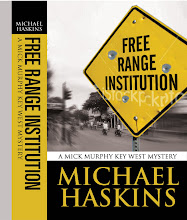
Michael Haskins

Saturday, November 17, 2007

Declan Burke's "The Big O" is coming to America!


Personally, I believe it is a good thing that Ireland’s biggest export is no longer its citizens. It has taken more than 100 years for the exodus to stop. What is the world to do without the Irish to be its police officers, politicians, publicans, and rogues? Don’t panic, the Irish are falling back on one of their oldest talents and traditions, the written word.

What I’ve heard from one Irish writer and journalist, Declan Burke, is that his second book, The Big O, has been bought by Harcourt and will be available in America by the fall of ’09.

I am so sorry for you, because it is a long wait for a fantastic read, especially for mystery fans. I can say that, because I’ve read both Burke’s books. All right, you want to know what you’re missing; I’ll give you a little hint.

Think of the ironic humor of Donald Westlake’s John Dortmunder novels, and throw in the black humor of a Carl Hiaasen Florida-misadventure novel. Mix up the humorous, determined, demented heroes and anti-heroes of these two fantastic authors and (I’m not done yet!) toss in some hardboiled writing, a lot like Elmore Leonard’s, and you have Declan Burke’s writing. Think of it as an Irish Stew of writing.

Carl Hiaasen should not read The Big O, because, while laughing himself silly, he will be banging his head against the proverbial wall because someone else created the anti-hero Rossi; a character that makes you laugh and then scares the bejesus out of you after the lights go off.

If you accept the premise that Dortmunder is not a good guy, but he ain’t bad either, you will agree with me that Karen and Ray, from The Big O, while not two of the most law-abiding citizens of the world, they’re not bad, just a little desperate and determined. After all, Ray wants to go straight and stop kidnapping for a shylock and Karen is only a stickup artist to help make ends meet, temporally. And the divorce of Dr. Dolan’s and the involvement of the female detective, Doyle, only complicate Ray’s criminal life.

I don’t really want to do a review of the plot and so forth, but I do want to say you will enjoy this book, if you like the writers mentioned above.

Ireland (home of my great-grandparents), is producing some terrific mystery writers these days and many of their books, sadly, are unavailable in the States. Though, some of their books can be ordered online, via Amazon’s European site. You can go to Burke’s http://www.crimealwayspays.blogspot.com/, where you will find some great reviews and discover how to order his book. Check his list of Irish writers, too. You will discover some great writers. Their websites are linked on his blog and worth checking out, if you are a mystery fan. You can also order The Big O on the site, but only I can say, “I was the first to read it!” It is okay with me, if you claim second place.

Tuesday, November 6, 2007

Who Reads Today?

It occurred to me, while I was preparing to send ARCs of “Chasin’ the Wind” to newspapers and other media outlets for reviews, that I am not sure people read much anymore.

As an example, Monroe County, where I live, is considering closing one or two libraries in the Middle Keys. I’ve read in the newspaper that other libraries are closing too. I also read, or hear from friends, about bookstores that are closing. I read a feature, recently, that indicated many newspapers have downsized their book review sections or have completely done away with them. Why? Because advertising revenues in those sections are down.

So, who reads today? Teenagers seem to do everything on computers and that includes reading. One teen I know, 16-year-old Alex Fierro, got through middle school with good grades in reading, but he read stories on the computer and tested about them on the computer. His summer reading required finishing two books and it was something he held off doing until a week before school. Do you suppose he received any pleasure from the books?

I don’t know about you, but to me, books and newspapers were meant to be held. I have always taken care of my books. When Hurricane Georges, 1998, blew through the Keys, it took my floating home, and about 1,000 books (mostly first editions) with it. I had spent most of my life collecting them.

I remember loaning my sister a book and watching in horror as she opened it and bent the spine! I yelled, I screamed, probably cried, while she told me that the book stayed open better after she did that.

Hands were made for many things, holding a drink, chopsticks, a sailing sheet, but mostly for holding newspapers and books. Maybe sitting in your favorite chair, a cup of café con leche, and the morning paper. Do you remember when there were afternoon editions of newspapers?

Obviously, I read blogs online and find myself squinting to read many of them. Some things can be read online, like directions from MAPQUEST or a blog, but never a book review! Blogs are like essays that once filled magazine pages. They are short and usually present one opinion, maybe defending it or just presenting it.

But books, a couple of hundred pages long, need to be held. Hell, EQMM and AHMM need to be held and they’re small magazines filled with marvelous short stories! I don’t think I know anyone who enjoys reading and buys books, who can read them on the Internet. Lord knows, there are some very good webzines that are filled with short stories, but reading a story on one, is not the same as holding it in your hands.

I spent weekends haunting used bookstores when I lived in Southern California. In Key West, I am a frequent visitor to Key West Island Books; owner Marshall Smith and I have formed an unusual friendship. Book people tend to be friendly and Marshall and I often discuss books. Notice I said “discussed,” because we don’t always agree on what is good or bad. We are entitled to our opinions, because we read the books we argue about.

Are books and bookstores a thing of the past? Obviously, there is a market for books, but is it declining and on the way to extinction? Will my home library, that I continue to rebuild since 1998, fall into the hands of grandchildren who will bend the spine of the books or taken them to Goodwill for resale?

What do you think?

Wednesday, October 31, 2007

How I lost my virginity this week

It has been a month since I last posted and, while there aren’t acceptable excuses for it, I do have reasons. First, my grandson, who I haven’t seen in almost 15 years visited from Germany and that allowed me to play tourist with him. Imagine a two-week vacation in Key West!

I survived that and then it was Fantasy Fest week! If you don’t know what Fantasy Fest is, check out
www.hogsbreath.com and click on ‘homemade bikini contest’ and watch the video, and that’s only one-tenth of what that week was like. Think Mardi Gras in the tropics.

So, for most of the month I haven’t worked on my sequel to Chasin’ the Wind, or done any blogging. I didn’t even do much reading and that, for me, is almost unheard of!

Anyone who has put pen to paper and then tried to sell it, knows the excitement of the envelope in the mail and then the agony of reading a rejection letter. If that made you give up, then you’re not a writer. If you went on, and continued writing, you are only an aspiring writer. But when you’ve sold something, when you open that envelope and there’s a contract in it, then you’re a writer! And when you get that first check, and make a copy to hangover your keyboard, you’re on your way!

But, alas, even at that point in our career we are still virgins as far as writing goes. Seeing a story we wrote in a magazine is a once-in-a-lifetime event and no matter how many times we see our byline in EQMM or AHMM, we cannot recapture that first time; but, in the world of the virgin, that is the equivalent of petting in the backseat!

So, you ask, how do you lose your writer virginity? I can tell you, because it happened to me yesterday. A large box of Advance Reading Copies (ARCs) arrived from the publisher (actually, I don’t care who they arrived from, just that they finally arrived!). I carefully cut the tape and nervously tossed aside the wrinkled up packing paper that sealed the space between the books and top of the box and there they were! There I was! My name, in larger than life letters, crossed the cover (never mind the book is the size of a trade paperback and an unedited proof to be sent out for reviews, it was the cover and my name and soon it would be a hardback) and something titillating ran through me and I realized that, finally, I am a writer and no longer a virgin!

I lived that moment for as long as I could, because I knew I would never experience that feeling again. No matter how many books are in my future, there’s only one first book, like there’s only one first short story sale, like there's only one first love.

I wish my twin daughters, Seanan and Chela, were closer, so I could have opened the box with them around and celebrated. Or, maybe my sister Patty Bolter, and we could have celebrated, but it wasn’t to be. I opened them alone and alone experienced a thrill of a lifetime. I’ll tell you something, all the rejections (and there were lots) were worth it, if this is what they led up to. I’ve worked hard to get this book published, just as I am working even harder on the sequel.

Of course, now the insecurity sets in! Someone at SleuthFest said writers were the most insecure people in the world. I believe him.

Sunday, September 30, 2007

Criminal Brief''s Guest Blogger

James Lincoln Warren, the mastermind behind the ever popular "Criminal Brief Blog," and short story writer, asked me to be a guest blogger for Saturday, Sept. 29th. I was honored. This is one blog I check and read daily. There is a link to the right, so if you are not a reader of Criminal Brief check it out. The following is what I wrote.

My love affair with the short story began in high school English class. Hemingway’s Nick Adams stories drove me to the library’s “books-for-sale” room. I even remember the book I bought, Hemingway’s “Men Without Women.” I soon followed it with “In Our Time.” Today, my home office shelves overflow with books, including many short story collections.
I believe the short story is the foundation of the writer’s craft. The discipline it takes to write one, to get setting, dialogue, and action to the barebones without losing the nucleus of the story is, as the publishing world once appreciated, the writers’ incubator.
I have read that the short story is considered close to its demise. The weekly and monthly magazines that flourished in the past have dwindled and the markets that once paid handsomely to publish new writers are almost extinct, unfortunately.
There is hope for us. Dell’s EQMM and AHMM monthly editions feature many of today’s most talented writers. The publications have risen to take the place of pulp fiction magazines of the ‘30s, ‘40s, ‘50s, and ‘60s, where Raymond Chandler, Dashiell Hammett, Talmage Powell, Carroll John Daly, and others first appeared. Their stories thrilled readers of the Dime Detective, Dime Mystery, Detective Tales, Ten Detective Aces, and G-Men Detective.
It is obvious that short stories and crime fiction have always shared a bond with readers and it continues today.
Other positive signs of life for the modern short story include the many regional noir-themed books that have begun to appear and are edited and written by writers from as far away as Dublin and as close as Los Angeles and New York. These noir editions may have an unusual affect on the novelists who submitted stories; could they become closeted short story addicts? Will we see more short works form them? One can only imagine.
We know anthologies are not moneymakers, because publishers tell us. So why do these writers write, if not for the paycheck? Have they discovered the euphoria of taking a complicated plot and whittling it down to twenty or less pages without losing its essence? Have they experienced the satisfaction behind mastering the challenge to make a character stand by his or herself, without an entourage? It is something to think about.
Boston mystery writer Jeremiah Healy, a prolific short story writer and novelist, asked me once what I was doing, after I had finished the final draft of my novel.
“Writing a short story,” I said and he replied, “Atta boy!”
Years ago, Dennis Lynds told me at an MWA So.Cal social that if I could master the short story, I could write anything. Dennis’ writing talents go unchallenged.
You would think, in a society craving instant gratification in everything from food to medicine, the short story would satisfy the public’s thirst for innovative fiction. As long as publishers refuse to promote story collections like the noir series, Dennis Lehane’s “Coronado,” James Lee Burke’s “Jesus Out to Sea,” or Laurence Block’s “Enough Rope,” the public will remain cheated out of the opportunity to read writing at its best.
There will never be a shortage of writers to tackle the risk of the short story; those of us who love succinctness in storytelling, and want to prove our worth with pen and ink, will always write. It is our passion and, sometimes, our curse.
With the number of Internet magazines and blogs coming online today, our stories now reach enthusiastic audiences from around the world; the rumored demise of our art has retreated into the shadows – to wither and die, hopefully.
Writers write and the desire to be published is only one of the driving forces. Another, the one we find hard to explain, is that we must write. People understand a paycheck, but when we write early in the morning or late at night, when we cloister ourselves in front of the computer without a paycheck in sight, friends and family begin to wonder about our sanity.
Try telling them it’s a love affair with language and story . . . on the other hand, tell them you believe in Leprechauns or have a Muse and maybe they’ll leave you alone, so you can do what you love. It works for me, but, hey, Key West is my Muse, and most everyone here believes in what others find unbelievable.

Sunday, September 23, 2007

Sailing, a metaphor for writing

This past Saturday, Sept. 22, my friends Burt Hansen, Paul Clarin and Jim Linder, helped me move my 36-foot sailboat, Mustard Seed, to the boatyard on Stock Island. As the eagle flies, it’s about a five-mile trek; as the boat floats, it’s at least double that.

Burt and I have sailed for years. He and his wife, Nadja, have sailed all around the east coast delivering boats and he has worked at boat sales at various times in his life. He is a weathered sailor I always learn something from when we are out.

This was Paul’s first time on my boat; he has sailed the Caribbean and is well versed in the pleasures and difficulties of sailing. Paul is a motorcycle enthusiast. He claims you get more miles for your dollar on motorcycles, as compared to boats. For a weathered sailor to go for speed with motorcycles is confusing. Sailing is about anything but speed!

Jim Linder is a Navy man, who has his own sailboat docked (and I say this with jealousy) behind his house on a canal. Jim and his wife, Barbara, have sailed with me before. He is a diver and a handy guy to have around if you have trouble (which we didn’t – knock on wood).

Okay, you ask, where’s the metaphor?

I don’t do an outline of my whole novel. I know the beginning, maybe some of the middle, and what I want the ending to be. I may have some chapter sketches of things that can happen, twists, phony leads, and such; and I have notes on character traits. The rest is self-driven, as I write.

This trip to the boatyard (where I will get the boat surveyed by Reef Perkins so I can get insurance, and the bottom will be painted) began with us meeting at the city marina slip at 8 a.m. We left the slip at 8:45, about 15-minutes earlier than I expected. I had a beginning to this trip and was pretty sure I knew the ending.

This short trip to Stock Island was planned to get going by 9 a.m. and to arrive around 2 p.m. Like a novel or short story, that was the beginning and the end. Reaching the end, like getting to the boatyard in this case, is what writing and sailing is all about.

Once that fist chapter is written, the book takes on a life of its own. After Mustard Seed was out of her slip, weather played a big part in the trip. We had knowledge, ability and equipment to work with, but weather was the unknown. It was cloudy, with a 50-percent chance of rain, expected 2-to-5-foot seas inside the reef, and we had our foul-weather gear, just in case.

For the first time in a long time, we actually set sails in the seaplane basin, off Fleming Key, with an outgoing tide. It was good sailing along the Key, around it into Key West Harbor. Even with the boat bottom in need of cleaning and painting, we were doing an average of 6-knots, the hull speed of Mustard Seed.

The story, once the first few pages fall in place, maybe with a little editing and rewriting after they are initially written, will usually achieve a level where it begins writing itself, going along smoothly.

Murphy’s Law (and my character’s name in Mick Murphy, so this applies) says the longer you go along smoothly the closer you are to a serious bump! And Murphy’s Law applies to writing and sailing (and life).

I have ideas that I intended to use to help move my story along, only to find that somewhere within the previous pages, things had changed and the idea wouldn’t work. Suddenly, I realize I need to make a bad guy good, or vise versa. Or I cannot work a shooting or action at the location I wanted, the weather has changed and if that is the case, what I had planned has to change.

We were sailing out toward the ship channel marker, past Fort Zackary Taylor, following the coast of Key West; railing almost in the water, doing a little more than six-knots and then the wind changed direction! If we trimmed the sails to catch the wind we would be traveling too close to the coast, where it would soon be shallow. Mustard Seed’s keel draws almost six-feet, so I try to keep her in 10-foot-plus water.

We had to tack, so we could use the wind to move away from where we were trying to go, so we could turn around and sail back into that direction, from a better position. It is time consuming and slows you down. But it is necessary, if you want to sail and not switch to motorboats! Shame on you for even thinking that!

I will usually reread what I’ve written, before I begin writing the next day. Even if I have finished a chapter, before I begin a new chapter, I reread the last one. As the pages mount, of course, I do not read from the beginning, but I do go a chapter or two back. If I am writing everyday, I may only read the last chapter. While I am doing this, I am also editing and/or rewriting. It takes time, but everything is still fresh in my mind, like what I was thinking and trying to accomplish as I wrote the day before.

Yeah, it slows down my writing time, especially if it’s in the evening and I’ve spent all day at my fulltime job, and only have a few hours to write. But, to get where I’m going, like tacking Mustard Seed, it is necessary.

So slowing down to tack may not be what I wanted to do, but it was necessary to get where I was going and the boatyard crew was waiting.

So, can you see the many similarities between sailing and writing? There is nothing as exciting and exhilarating as full sails and the rail in the water and the quiet of carving your way through the seas; it’s a lot like sitting down at the keyboard and writing a chapter that goes along smoothly and feels right all along the way.

As they say when you're sailing, "Don't pee into the wind."

Monday, September 10, 2007

Memories of "On the Road"

There has been a lot of press recently on the release of the original scroll version of Jack Kerouac’s “On the Road” manuscript.

You want to get depressed? I lost, in Hurricane George, 1998, a first edition of "On the Road." Yeah, it was beat up, but that’s because I’d read it so often and somehow kept it with me on my moves around the country. But that’s a whole other blog.

I was born after Kerouac began his journey with Neal Cassady, Allen Ginsberg, Gregory Corso and William Burroughs. The travels produced more books than "On the Road." I grew up on the fringes of the Beatnik generation. My interest in writing came from them. That is also the reason I was never into the hippie movement in the '60s. I didn’t want to drop out, I wanted to create, and I wanted to experience life, to live life, like the men and women who roamed the pages of "On the Road," "Big Sur," "Mexico City Blues," and so many others.

I have read the different newspaper accounts of the scroll edition, the NY Times, the LA Times, and a few others that have shown up on blogs. Years ago, I worked on a Boston newspaper, as a weekend copyboy, and know what a scroll really looks like, how heavy it is. I helped change out scrolls on wire service machines, back in those days. I also learned to write on a manual typewriter, where most of you have probably never used one – probably never seen one.

Before computers and the Internet, news stories came from wire services – AP, UPI, Reuters – via a machine that filled the newsroom with clatter 24/7. When you cut-and-paste today, you probably don’t know where the term came from. Back in the days before computers, when a reporter had to edit his/her copy he had to literally cut the copy and paste it together with the corrections.

What we do today, what I’ve done already on this copy, is not cut-and-paste. You know why? Because there’s no white glue to lick off my fingers. And there are no drops of spilled glue on the keyboard or desktop.

Today, I write a few pages, go have a café con leche and then come back and do a little rewrite. I enjoy the rewriting, probably because I did it years ago when cut-and-paste was necessary and it was work. Today, it is really enjoyable, especially if it makes what I am writing better. Ah, I think to myself, a breeze.

When Kerouac sat down to write “On the Road,” he loaded the scroll into his manual typewriter and began writing. Because it was, I am told, a stream of consciousness, his editing was probably limited to spelling (maybe).

I’ve spent too much time daydreaming, since reading the press on Kerouac. It was a whole different world then. While you may not think writing is easy today (and I agree, it ain’t) it was a lot more work in the ‘50s, ‘60s and ‘70s. Journalists certainly put a lot more thought into what they typed onto that sheet of paper, because if they got it wrong, it was a messy, time-consuming cut-and-paste project to fix it. Today, it’s a few keystrokes and, like magic (believe me) the correction/addition goes smoothly into place and there’s no mess.

Imagine, if you will, how much more Hemingway could’ve written with a laptop on the Pilar or in Africa or on the bar top at the Floridita. Or Michener or Faulkner . . . or Kerouac.

The scroll edition of “On the Road” will be read by a lot of people, young and old, but there will be a few of us withering Beats who will smile and remember our times and adventures; I will do that, but I will also think of the scroll as in unraveled on the floor and see Kerouac hitting the return bar on his typewriter, smoking a cigarette and drinking a cup of coffee. I will laugh at the scene of him standing on his head so fresh blood would move to his head and help him get rid of his hangover. I don’t know if it worked for him, but it only made me sicker!

If you want to know more about the Beats, go to my friend Mark Howell's new blog: http://www.abouthebeats.blogspot.com/.

Sunday, September 2, 2007

Mother Teresa or truth is stranger fiction

Mother Teresa’s rough face, aged with lines, large brown eyes, and colored from outdoor living, stared from the front of TIME’s Sept. 3, 2007, issue. I half expected to read she had received sainthood from Rome, but large white letters screamed “The Secret Life of Mother Teresa” and small white print whispered “Newly published letters reveal a be loved icon’s 50-year crisis with faith.”

Last week, Bill Maher, host of “Real Time with Bill Maher” on HBO, showed off the magazine and even kissed it, referring to Mother Teresa as one of his. Of course, he meant nonbeliever.

A new book is coming out, or maybe is already out, that reports Mother Teresa had concerns about her faith. It is proven, the reports indicate, in letters she had written during her life. Even with her questions about faith and God, the woman continued her mission of helping the poor. Of course, most of us have no idea of the class of poor Mother Teresa worked with.

I remember when she came to Tijuana, Mexico, one of my favorite cities. Poverty in Tijuana is hard to explain. It is even harder to witness. Slums in Tijuana would make the slums of NYC and Boston seem like luxury living. Wealth also is in surplus in Tijuana. Living side-by-side, they highlight the obserdity of life.

I bring this up, because people have asked me where I get my story ideas. It may seem like a simple question by those asking, but it really doesn’t have a simple answer. Sometimes ideas come out of the blue from a newspaper article or a news story on television. I write mysteries, so there is usually an iota of truth/fact in the story. Then I add “what if” to it and I am off and running.

An idea doesn’t have to give me a theme for a book. It can help me with character development, as the Mother Teresa story is going to do. In my novel, “Chasin’ the Wind,” and my EQMM short story, “Murder in Key West,” there is a Jesuit who sees and communicates with angels. I leave it up to the reader to believe Padre Thomas can do this or not. He is an Irish Jesuit whose missions have been in Central and South America, hence the “Padre” before his name.

Padre Thomas walked away from his mission in Guatemala and ended up in Key West, where my protagonist, Liam Michael “Mad Mick” Murphy meets him at Schooner Wharf Bar. Obviously, Padre Thomas is having a problem with faith, or he would have remained at his mission. He is still religious, donates his time at the Catholic soup kitchen and even helps counsel many of the men and women who come to the kitchen for a daily meal.

I guess that would be something like Mother Teresa’s continuing her work as she battled with her faith. I don’t know if I will read the book, but the story in TIME has given me some good background material I can include in Padre Thomas’ battle with faith. In my sequel, “Free Range Institution,” I have the Jesuit continue his battle with his faith and I end the book with him violating his beliefs, but there are strong circumstances behind it.

If I had chosen to write about Padre Thomas’ questions with faith without doing some background, it probably wouldn’t have come across properly – which I hope it does. Now, with the material from TIME I have more directions for him to go.

One of my research tools was, fortunately, a friend who came to me after his wife had read my short story and told me he was an ex-Jesuit. Imagine my surprise! He graciously met me after work one day and told me about his life and answered many of my questions. I had pretty much captured the spirit of the order in Padre Thomas, but the interview helped me increase his character in the sequel. I also learned a lot. Did you know the Jesuit order does not report to the pope? The head of the order is equal to the pope! I am still looking into this, because it was one of only a few things that caught me totally by surprise. I expect in the sequel to the sequel that information, along with what I’ve gleamed from Mother Teresa’s crisis with faith, will make its way into Padre Thomas’ character and may – no, probably will – affect my character’s actions and reactions in the second sequel.

So where do my story ideas come from? I guess you could say from real life, but I tone them down so they are believable.

FEEDJIT Live Traffic Map