There has been a lot of press recently on the release of the original scroll version of Jack Kerouac’s “On the Road” manuscript.
You want to get depressed? I lost, in Hurricane George, 1998, a first edition of "On the Road." Yeah, it was beat up, but that’s because I’d read it so often and somehow kept it with me on my moves around the country. But that’s a whole other blog.
I was born after Kerouac began his journey with Neal Cassady, Allen Ginsberg, Gregory Corso and William Burroughs. The travels produced more books than "On the Road." I grew up on the fringes of the Beatnik generation. My interest in writing came from them. That is also the reason I was never into the hippie movement in the '60s. I didn’t want to drop out, I wanted to create, and I wanted to experience life, to live life, like the men and women who roamed the pages of "On the Road," "Big Sur," "Mexico City Blues," and so many others.
I have read the different newspaper accounts of the scroll edition, the NY Times, the LA Times, and a few others that have shown up on blogs. Years ago, I worked on a Boston newspaper, as a weekend copyboy, and know what a scroll really looks like, how heavy it is. I helped change out scrolls on wire service machines, back in those days. I also learned to write on a manual typewriter, where most of you have probably never used one – probably never seen one.
Before computers and the Internet, news stories came from wire services – AP, UPI, Reuters – via a machine that filled the newsroom with clatter 24/7. When you cut-and-paste today, you probably don’t know where the term came from. Back in the days before computers, when a reporter had to edit his/her copy he had to literally cut the copy and paste it together with the corrections.
What we do today, what I’ve done already on this copy, is not cut-and-paste. You know why? Because there’s no white glue to lick off my fingers. And there are no drops of spilled glue on the keyboard or desktop.
Today, I write a few pages, go have a café con leche and then come back and do a little rewrite. I enjoy the rewriting, probably because I did it years ago when cut-and-paste was necessary and it was work. Today, it is really enjoyable, especially if it makes what I am writing better. Ah, I think to myself, a breeze.
When Kerouac sat down to write “On the Road,” he loaded the scroll into his manual typewriter and began writing. Because it was, I am told, a stream of consciousness, his editing was probably limited to spelling (maybe).
I’ve spent too much time daydreaming, since reading the press on Kerouac. It was a whole different world then. While you may not think writing is easy today (and I agree, it ain’t) it was a lot more work in the ‘50s, ‘60s and ‘70s. Journalists certainly put a lot more thought into what they typed onto that sheet of paper, because if they got it wrong, it was a messy, time-consuming cut-and-paste project to fix it. Today, it’s a few keystrokes and, like magic (believe me) the correction/addition goes smoothly into place and there’s no mess.
Imagine, if you will, how much more Hemingway could’ve written with a laptop on the Pilar or in Africa or on the bar top at the Floridita. Or Michener or Faulkner . . . or Kerouac.
The scroll edition of “On the Road” will be read by a lot of people, young and old, but there will be a few of us withering Beats who will smile and remember our times and adventures; I will do that, but I will also think of the scroll as in unraveled on the floor and see Kerouac hitting the return bar on his typewriter, smoking a cigarette and drinking a cup of coffee. I will laugh at the scene of him standing on his head so fresh blood would move to his head and help him get rid of his hangover. I don’t know if it worked for him, but it only made me sicker!
If you want to know more about the Beats, go to my friend Mark Howell's new blog: http://www.abouthebeats.blogspot.com/.
Monday, September 10, 2007


Sunday, September 2, 2007
Mother Teresa or truth is stranger fiction
Mother Teresa’s rough face, aged with lines, large brown eyes, and colored from outdoor living, stared from the front of TIME’s Sept. 3, 2007, issue. I half expected to read she had received sainthood from Rome, but large white letters screamed “The Secret Life of Mother Teresa” and small white print whispered “Newly published letters reveal a be loved icon’s 50-year crisis with faith.”
Last week, Bill Maher, host of “Real Time with Bill Maher” on HBO, showed off the magazine and even kissed it, referring to Mother Teresa as one of his. Of course, he meant nonbeliever.
A new book is coming out, or maybe is already out, that reports Mother Teresa had concerns about her faith. It is proven, the reports indicate, in letters she had written during her life. Even with her questions about faith and God, the woman continued her mission of helping the poor. Of course, most of us have no idea of the class of poor Mother Teresa worked with.
I remember when she came to Tijuana, Mexico, one of my favorite cities. Poverty in Tijuana is hard to explain. It is even harder to witness. Slums in Tijuana would make the slums of NYC and Boston seem like luxury living. Wealth also is in surplus in Tijuana. Living side-by-side, they highlight the obserdity of life.
I bring this up, because people have asked me where I get my story ideas. It may seem like a simple question by those asking, but it really doesn’t have a simple answer. Sometimes ideas come out of the blue from a newspaper article or a news story on television. I write mysteries, so there is usually an iota of truth/fact in the story. Then I add “what if” to it and I am off and running.
An idea doesn’t have to give me a theme for a book. It can help me with character development, as the Mother Teresa story is going to do. In my novel, “Chasin’ the Wind,” and my EQMM short story, “Murder in Key West,” there is a Jesuit who sees and communicates with angels. I leave it up to the reader to believe Padre Thomas can do this or not. He is an Irish Jesuit whose missions have been in Central and South America, hence the “Padre” before his name.
Padre Thomas walked away from his mission in Guatemala and ended up in Key West, where my protagonist, Liam Michael “Mad Mick” Murphy meets him at Schooner Wharf Bar. Obviously, Padre Thomas is having a problem with faith, or he would have remained at his mission. He is still religious, donates his time at the Catholic soup kitchen and even helps counsel many of the men and women who come to the kitchen for a daily meal.
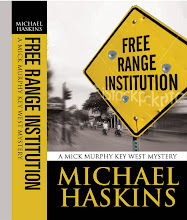
I guess that would be something like Mother Teresa’s continuing her work as she battled with her faith. I don’t know if I will read the book, but the story in TIME has given me some good background material I can include in Padre Thomas’ battle with faith. In my sequel, “Free Range Institution,” I have the Jesuit continue his battle with his faith and I end the book with him violating his beliefs, but there are strong circumstances behind it.
If I had chosen to write about Padre Thomas’ questions with faith without doing some background, it probably wouldn’t have come across properly – which I hope it does. Now, with the material from TIME I have more directions for him to go.
One of my research tools was, fortunately, a friend who came to me after his wife had read my short story and told me he was an ex-Jesuit. Imagine my surprise! He graciously met me after work one day and told me about his life and answered many of my questions. I had pretty much captured the spirit of the order in Padre Thomas, but the interview helped me increase his character in the sequel. I also learned a lot. Did you know the Jesuit order does not report to the pope? The head of the order is equal to the pope! I am still looking into this, because it was one of only a few things that caught me totally by surprise. I expect in the sequel to the sequel that information, along with what I’ve gleamed from Mother Teresa’s crisis with faith, will make its way into Padre Thomas’ character and may – no, probably will – affect my character’s actions and reactions in the second sequel.
So where do my story ideas come from? I guess you could say from real life, but I tone them down so they are believable.
Tuesday, August 14, 2007
Writers need a bit of snake-oil-salesman's charm
Waiting for March ’08, when my book “Chasin’ the Wind” finally makes it into bookstores, has been frustrating. I turned in the final copy of the novel to the first editor in mid December. I would take it as personal if the publishers’ panel at SleuthFest, held in Miami in March, hadn’t discussed that it takes up 16 months from acceptance to publication.
After the New Year, I began working on a sequel, though I had no guarantee that the publisher would take it. Again, the publishers’ panel at SleuthFest talked about sales driving publishers’ desire for a sequel to a first novel. Sales! Not commitment to the author. Less we forget, publishing is a business and a dwindling business at that. Small publishers, God bless ‘em, are the best hopes for publishing a first novel.
The advance is small, but they will look at works from un-agented writers. Trying to get a reliable agent is a whole other blog and horror story! So there’s only a small advance and, most likely, no money to help in a book signing tour. The print runs are low, also. And a second printing is going to depend on (you guessed it!) the early sales.
My publisher, Five Star, does send out copies of the book to reviewers and that is a positive. A few good reviews will help sales and the early ones may even get on the back jacket of the book. A real good one from something like the New York Times Review of Books would probably make it on the cover! Of course, a NYT review would definitely help sales.
It is up to the writer to promote his/her book and make sales. May son-in-law, Paul Carpino, works in a business with a marketing department and he was able to get me a list of all the major US newspapers’ book editors and their addresses. Some were on the Five Star distribution list, but many weren’t. Five Star will give me up to 15 books to send for reviews. So, from the list I have to choose 15 publications to send copies of my book to. It’s one step toward sales.
LA writer Robert Crais reminded me that many of the bookstores I haunted when I lived in LA were still open, and he suggested I test the waters by approaching them. I did last June, when I visited LA, and received positive responses from Mysteries to Die For, in Thousand Oaks; the Mystery Bookstore, outside UCLA; Flintridge Bookstore and Coffeehouse, in the La Canada-Flintridge neighborhood; Dutton’s, in Brentwood; Book ‘Em, in South Pasadena, and Mystery & Imagination, in Glendale.
I will be touching base again, after the reviews come out, and send my press package of review clips, book cover art, my photo and blurbs form other writers. And a T-shirt with the book cover on the back and a little blurb on the front with my website address. I just hope I don’t send a large to someone that would fit nicely into a small!
Yeah, T-shirts are another way of promoting the book. I expect to give away many and, with a little luck, sell a few to help make up the costs. I am fortunate to have Bill Lane, from Fastlane Advertising (www.fastlaneadvertising.com), as a friend and he has helped me with suggestions on promo ideas and some great art.
T-shirts and postcards are not that expensive and if some of the T-shirts sell at the signings, they may pay for themselves. The postcard will go in my press package and, hopefully, the bookstores will leave them on the counter or put them in the bag with purchased books.
I thought about bookmarks, but then realized most of the stores already had bookmarks that promoted their store. I didn’t want to be in competition with them, so I am going with the postcards. Postcards are also bigger than bookmarks and may get a second look when it comes out of the bag and before it’s thrown away. Maybe it will be saved and stuck on the frig, as a reminder of a book to buy.
Another good promotional item is the local library. Monroe County has a library system that includes three or four branches between Key West and Key Largo. Speaking to reading groups and the Friends of the Library will help sell books and the writer. If only a handful of people show up, and even if none of ‘em buys a book, and if I give a good presentation, they will talk about my book and me to friends and eventually some of them will buy copies.
I talked to Tom Corcoran, who can fill a movie theater in Key West when he signs, about how he does so well on stage. Especially with his readings. He had a great suggestion. He told me to pick a few short paragraphs, maybe from different sections of the book, and read them. They don’t need dialogue, he said and that made me feel better. I’ve been to readings where the writer reads dialogue and takes on the roll of each speaker. I am not up to that quality.
Another point Tom talked about was making the piece read leave the reader wanting to know more. Don’t tell ‘em too much and leave them wanting what followed. Sounds like an old fashioned snake oil salesmen’s pitch, don’t it?
Now I need to sit down and worry, because writers are such an insecure bunch; most of us, anyway. I will keep working on the sequel, hoping to finish it by September and then get to work on a short story I’ve blocked out. Jerry Healy told me to keep writing after the novel is finished and the short story works best for me.
If you have any ideas on self promotion, let me hear them.
Friday, August 10, 2007
More story ideas or why I drink
If you read an earlier blog, you know my friend Art, one of the managers of the Hog’s Breath Saloon, has decided to write a novel. I think his words were something like, “If you can do it, so can I!” He's discovering it is not as easy as he thought.
“I read you recent blog,” Art said and bought me a Jameson on the rocks. “Insightful,” he nodded and smiled.
I knew there was more to come, so I waited and sipped my Jameson.
“Thank you, Art,” I finally said.
The Carter Brothers, Tim and Danny Carter, were setting up on stage and when they began to play I wanted to listen, so I needed Art to get to what concerned him about writing.
“How’s the novel coming?” I took a sip of whiskey, to keep from smiling too widely.
“I haven’t gotten to the writing, yet,” he mumbled.
“You’re plotting?” I said without looking at him. “Good way to go, for the first one. Get all your ducks in a row.”
“I’m looking for a fresh idea.” He still mumbled. He moved closer. “When you read the newspapers and magazines, what do you look for? I mean, to stimulate your ideas?”
I lit a cigar and turned in my barstool. “Something unusual. Maybe a little quirky.”
“How do you know if it’s unusual or quirky?” He lit a cigarette and sat down.
“Art, you’ve lived here too long,” I finally laughed. “If you find something in the paper that strikes you, a long-time resident of Key West, as unusual or quirky, you can bet your paycheck that the rest of the world will think so too.”
“Okay,” he sighed, and I knew he wanted more. “How do you incorporate it into your story?”
“Maybe you do, maybe you don’t,” I blew thick cigar smoke into the night. “Sometimes I cut it out and file it for a future date.”
“Why?”
“Because later I may remember it and that way I have it to reread.” The Carter Brothers were almost ready to do a sound check. “I don’t trust my memory. I clip newspapers and magazine stories, I take notes of things I hear and people I see.”
“Why?” he frowned.
“Because, if I hear an unusual phrase, I want to save it, to remember it, so I write it down. Or I run into a person with a trait I think a character could have, I write it down.”
“Can you give me an example?” He twisted in his seat.
I looked around the large outdoor bar. It was getting crowded, as show time approached. Across the bar a young women, dressed in black, with dyed black hair, black nail polish and a pierced nose, sat talking to a young guy who dressed like a yuppie. They were talking into each other’s face, but not touching.
“See the couple over there?” I nodded toward the couple. “She’s Gothic and he’s a yuppie, probably on vacation together. I see that and I wonder why? What do they have in common?”
“Sex?” Art suggests.
“That’s a good first guess, but how’d they get to the point of sex?”
Art studied the couple and smoked another cigarette. “They guy’s sister is married with kids and she was the baby sitter.” He spoke quickly and smiled when he’d finished.
“Good, Art. And maybe at home he’s ashamed to be seen with her, so they’ve escaped to Key West.”
“Yeah,” Art agreed. “And they want to make a life together here.”
“But, you’re forgetting something, Art.”
“What?”
“This is a mystery novel, so there has to be some mystery. A murder or a robbery or both.”
“Maybe to get the money to move here they committed a robbery and someone was killed?”
“That’s workable,” I told him and finished my drink, hoping he’d buy me another before the band started.
“I think it could be a short story,” he said, as he removed a small notebook and pen from his shirt pocket. “I need to get this down,” he said and began writing in the notebook.
I ordered a fresh drink from Frank and when I turned around Art was walking away, muttering to himself. It might have been dialogue and he wanted to hear how it sounded.
Tuesday, August 7, 2007
Where do your story ideas come from? Or, truth is stranger than fiction!
As a writer, I read newspapers and news magazines. It’s as mandatory as writing, as far as I’m concerned. I read to stimulate ideas. I don’t always spend time on the headlines, but look for the short pieces that carry unusual news. You never know when something strange might kick your imagination into gear. I can read a piece from Alaska and ask myself, “what if, in Key West . . .?”
I also watch TV news, both the Miami channels and CNN.
I watched, as most of the world did, in horror recently as the bridge in the Twin Cities collapsed. It was caught, wide angle, on a surveillance camera. It looked like something out of the new Bruce Willis Die Hard movie.
Of course, it wasn’t entertainment. It was death of innocent men and women and destruction. Today, days later, the disaster is still affecting the daily lives of the people that drove over that bridge to go to work, to go out for dinner, to go on a date, to go home from picking kids up at day care. It is unimaginable.
Or is it?
It was a very visual event, both during and afterward. Maybe, because of the visual affect I thought of the movies instead of a book. I’m sure I am not the only mystery writer who watched the TV footage and wondered what kind of story he/she could build around the tragedy. It’s what we do. I said a silent prayer for the victims and their families, but that was all I could do from Key West.
I don’t know if I will use the incident, but we do have a lot of bridges – one is seven-miles long – on the ride from Miami to Key West, so the possibility is there. In the newspapers, I’ve followed the reports about the condition of bridges throughout the United States.
An optimist might say it’s a good report because there are so few bridges in the same condition, or worse, than the one in Minneapolis; a pessimist might say it was a bad report, a warning of our failing infrastructure. I think most writers are, in their writing, pessimists because that’s where the mayhem comes from. Optimists don’t often commit mayhem; I don’t like to say never. But I think you get my point.
So, is truth stranger than fiction?
I have a family friend who lives in Orlando and doesn’t visit because of her phobia of driving over bridges in the Keys. I used to laugh at her phobia. I assumed that our bridges were safe because the government was looking out for our safety!
After the disaster in Minneapolis, I am beginning to wonder if government regulators and agencies do their jobs. Is the FAA really doing its job with the airlines? Traffic controllers? I'm having second thoughts.
Imagine a book that’s premise is the demise of America through the failure of its infrastructure. Where would you begin it? With the roads and bridges? The airlines? Communications? The legal system?
When I open the morning paper now, my hands shake because what I am seeing is the origins of a great thriller and you and I are characters in it. There’s a clown leading the nation, a Congress of inept (at best; corrupt, in a worse case) men and women who have not accomplished anything in almost eight years, even though the voting public told them to do something.
The list goes on and on. I’m sure you can add to it from your city or county. I guess another thing reading and searching through newspapers teaches is that truth is stranger than fiction, and less believable.
Where do your story ideas come from?
Tuesday, July 10, 2007
Sometimes small packages hold big surprises!
I recently flew into smoggy LAX and was picked up by my niece, Alexis Bolter, and we met my sister Patty – Alexis’ mom – at a small café in Brentwood for lunch. My sister lives in Malibu, where the temperatures hovered around the mid 70s! I came prepared for summer and explained that 74-degrees was winter temps in Key West. I needed to borrow a sweatshirt to sit outside with them, in the evening.
After unpacking, I checked my e-mails at home. Of course, I am not there and I receive an e-mail from an editor saying he had attached an edited copy of my book and that I need to go through it and yeah or nay the corrections. Most of the editing had to do with punctuation after quotes. Let me simplify it, after a quote I used a comma when the words were spoken as the speaker did something while talking.
Example: “I think you should’ve shot him,” Norm tied his shoes and smiled. I thought that was correct, the editor doesn’t. Now, example: “I think you should’ve shot him.” Norm answered the phone. I thought that was right, and the editor agrees. So, now I have to print out the whole manuscript and reply by line, by page that I agree or do not.
There are a couple of other things. They question my spelling of “Durty.” The name of the bar is “Durty Harry’s,” so I have to explain why I spelled it that way. I am saving this project for when I get home.
Wednesday morning Patty drove me to South Pasadena and I visited Barry at Book ‘em, a mystery bookstore I used to haunt when I lived in the LA area.
I put together a small package with a copy of the March/April issue of EQMM with my short story in it, a list of blurbs from writers about my book, and a brief synopsis of the book, and a color photo of me. The idea for that is that if they were going to do a signing they could post the info and photo. I also included a sheet from the publisher giving the store a 40-percent discount on its order, if the books were for a signing.
Patty and I were joined by my friend Norm Cote and his wife, Annie, for lunch at Damon’s in Glendale. Norm and I go back a long way and it was nice getting to see him again. After lunch, I went to Book Fellows down the street from Damon’s and left my package, since Christine who owns the shop is only available on Sunday and Monday.
James Lincoln Warren, a SoCal member of Mystery Writers of America, met me Thursday at Mystery Books in Westwood, where he introduced me to the bookseller and I left my package. We had lunch and then James took me to Dutton’s in Brentwood, where I dropped off another package.
Dutton’s made the news recently, because the property owner has plans to teardown the building and go high-rise. Apparently, the store’s regular customers raised hell and the media has reported that the new building will house the bookstore. I went to a lot of signings in that old building and am glad it isn’t going away, but it will lose something – in my opinion – when it moves into a modern building.
Check out James' blog, Criminal Brief, a link is off to the right.
Friday, I had an interesting experience. While still in Key West, I received a report that a new neighborhood bookstore was opening in Flintridge, Ca. I e-mailed the store and asked about dropping by and received an e-mail back saying to come in. I met Sandy Willardson, the store’s event coordinator, and we discussed my book and website. The Flintridge Bookstore and Coffee House has a nice mystery section and I look forward to signing there. In talking with Sandy, she mentioned she also does event coordination for Vroman’s Bookstore in Pasadena. Vroman’s has two stores in Pasadena and has to be one of the oldest in the area. Of course, I said yes!
I think that's the whole purpose of this post. Never judge a bookstore by its size or location. I will gladly sign wherever I am asked, and in the case of the Flintridge Bookstore, it turned into an opportunity to sign at one of Pasadena's oldest and largest stores.
As soon as I can confirm a publication dates, it looks like I will have a few book signings in the LA area. If you are close by, I hope to see you there.
I am off to look at the edited version of my book. I need to print it first … oh well, I’ll tell you all about it, later.
Saturday, June 23, 2007
Summer thoughts
I had wrist surgery for tendonitis the middle of June and enjoyed the company of my twin daughters, Seanan & Chela, along with Seanan’s husband Paul and Chela’s fiancé Bryan and Paul’s friend Guy, a NYC cop, and his wife Jodi, while I recouped.
I did spend a little time editing the sequel to “Chasin’ the Wind,” “Free Range Institution,” during this time, but typing a few thousand words was out of the question.
Before the surgery, I wanted to reach page 200 and I beat it by one!
I see Dr. Collins (no relation to Padre Thomas Collins in my books) on Monday morning to have the stitches removed and I expect he will release me with no restrictions. So it will be back to the gym (and after the time off, I need it!) and the keyboard. I hope to have the sequel to “Chasin’ the Wind” done before the end of summer, let it sit for a month and when my grandson Shane comes in October for a couple of week I will use my mornings to edit/rewrite.
Now I am on my way to visit my sister Patty and her family in Malibu, California. I am actually using the trip to visit some of the bookstores I haunted while I lived in Southern California and pitch my book, in hopes they will order it and welcome me back for a signings in March or April.
I am also looking forward to seeing my long-time friend Norm Cote and his wife Annie while I am in LA. Norm and I share a lot of history, most of it exciting and revolving around boxing in LA and bullfights in Tijuana, Mexico. My other good West Coast friend Rob Murdock will be out of town while I am there, so I will miss the opportunity to swap lies with him.
Thank you for taking the time to check out my blog and please take a look at my website – www.michaelhaskins.net – if you haven’t already. I will get back to keeping the blog as up to date as possible after July 4th.
Subscribe to:
Posts (Atom)